- 01Prescription Telemedicine, run on LastStop
- 08LastStop, the framework
- 09Patient intake
- 10The case queue
- 11AI at work
- 12Integrations 1 · Bring your own EHR
- 13Integrations 2 · Contracted clinician network: Beluga Health
- 14Seen, prescribed, sent
- 15Integrations 3 · Hallandale Pharmacy
- 16Fulfilment and tracking
- 17Integrations 4 · Payment processing
- 18Integrations 5 · The full catalog
- 19The patient portal
- 20Refills
- 21Secure messages
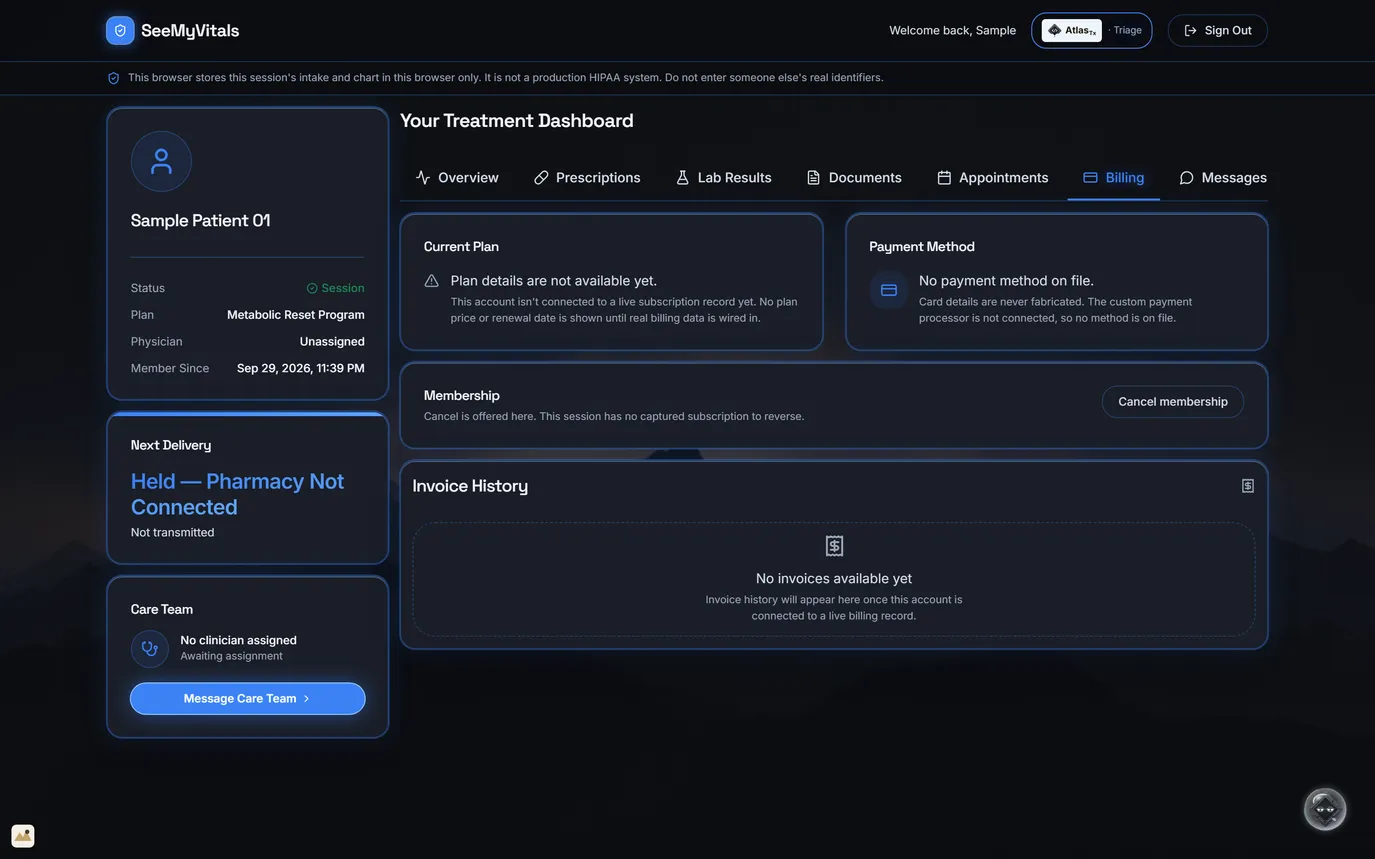
- 22Billing, stated plainly
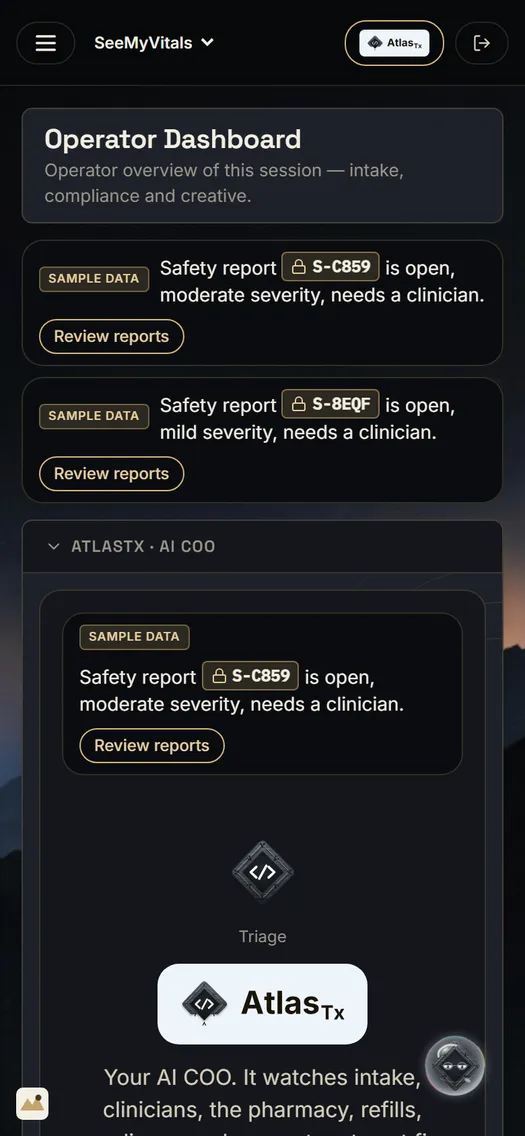
- 23On a phone
- 46What it takes off the payroll
- 47What's real today
- 33Compliance: the section you don't skip
- 34ClaimRight
- 35Outcome guarantee: blocked
- 36False FDA claim: blocked
- 37FDA status on every program page
- 38LegitScript readiness
- 39Text consent, STOP and quiet hours
- 40Prescribing rules by state
- 41Visit before prescribe
- 42Clinician licence check
- 43AI drafts, a person decides
- 44The audit log
- 45Blind Atlas, from the fire card
Prescription Telemedicine, run on LastStop
Intake to pharmacy, ads to audit, on one console.
- SeeMyVitals is a telehealth practice brand shown on LastStop, the platform it runs on. The SeeMyVitals wordmark and palette are a placeholder made for this demo.
- AtlasTx is the AI COO built in. It ranks the practice's day and works on record codes, never names.
- Every screen is from a local demo build with labelled SAMPLE records. No patients, orders, revenue or certifications are claimed.
- Vendors without a signed agreement are marked "Demo connection — agreement pending". Nothing is sent to them.
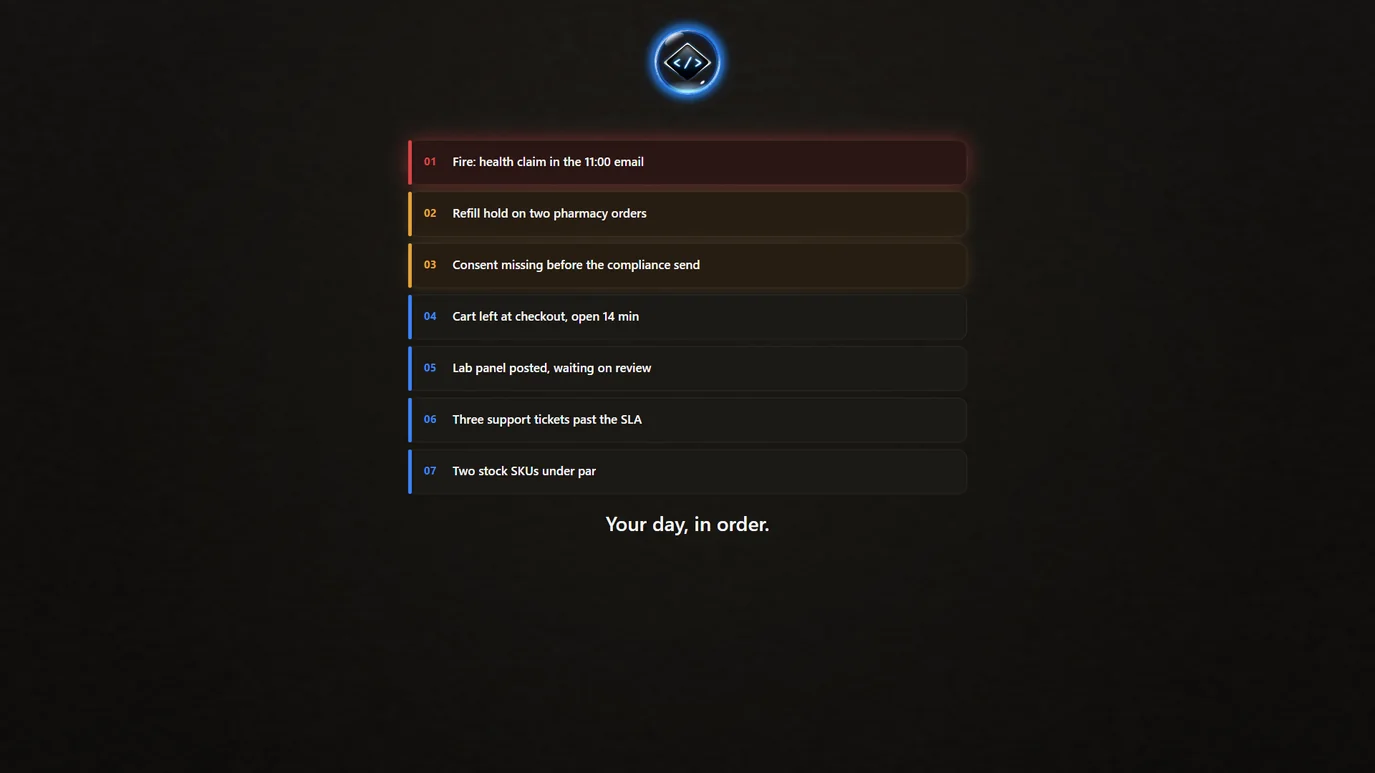
The AI
AtlasTx, your Triage COO
Every open item in the practice, in one list, in the right order.
- The dashboard opens on AtlasTx. It watches intake, the clinician queue, the pharmacy, refills, compliance flags and support.
- Every record is named by a random code with a lock chip (for example S-C859), never by a patient's name.
- Atlas ranks every open item inside the app.
- Open safety reports sit above everything else; a clinician reviews every one.
- Nothing runs until someone presses Run AtlasTx.
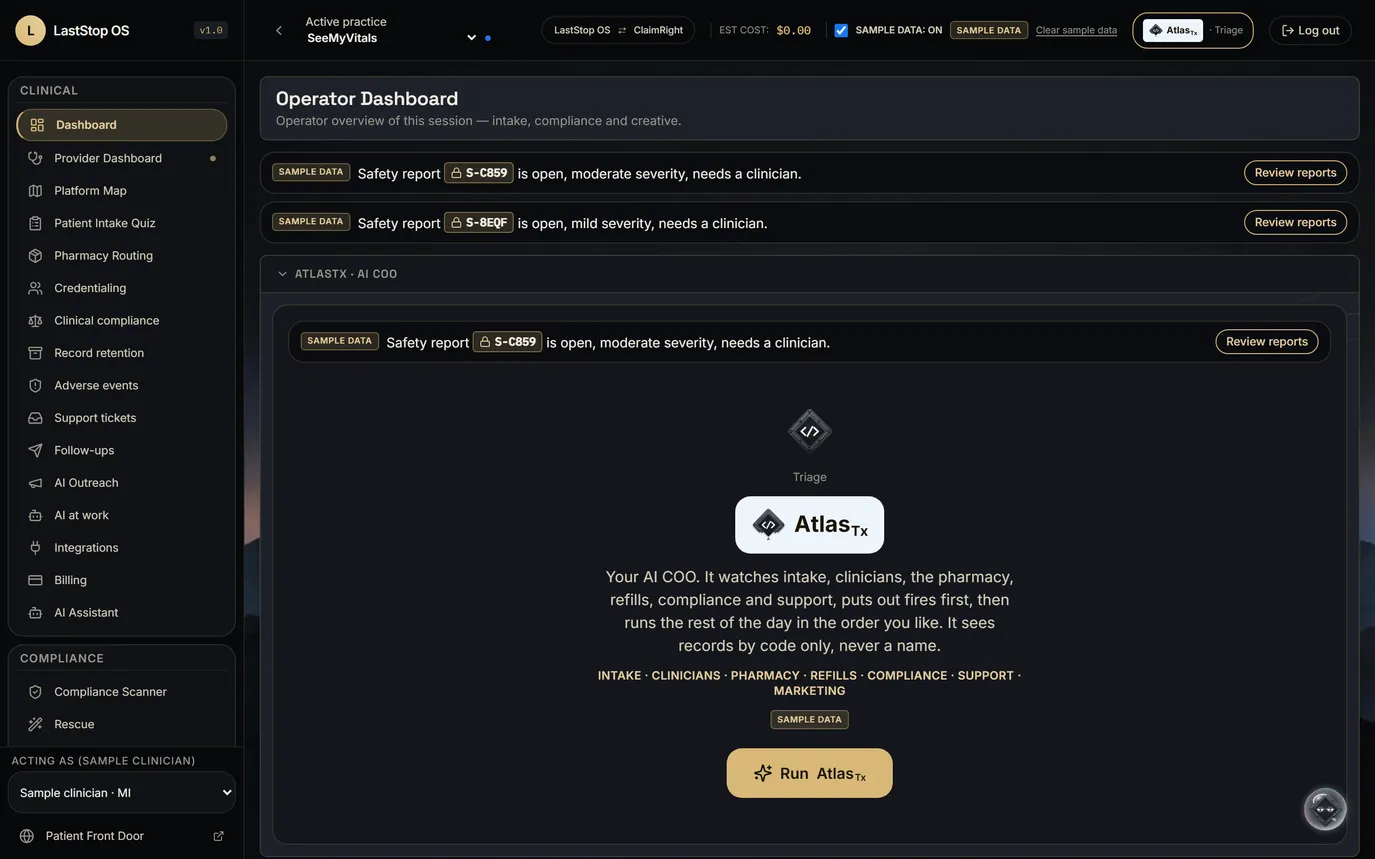
The run
- What a run does: open items stream in from intake, refills, the pharmacy, support, compliance, payments and messages; AtlasTx takes them in; the ranked list comes out one card at a time.
- This is an illustration drawn in code, not a screen recording. The item count in it is illustrative.
- In the product, the run is one button: Run AtlasTx.
- In the illustration the first card is a health claim caught in a scheduled email. In the practice, the fire card holds the worst open safety report and anything held at the pharmacy.
- Every card carries a record code, never a name.
Press Run. It pulls in the whole practice, then hands back your day in order.
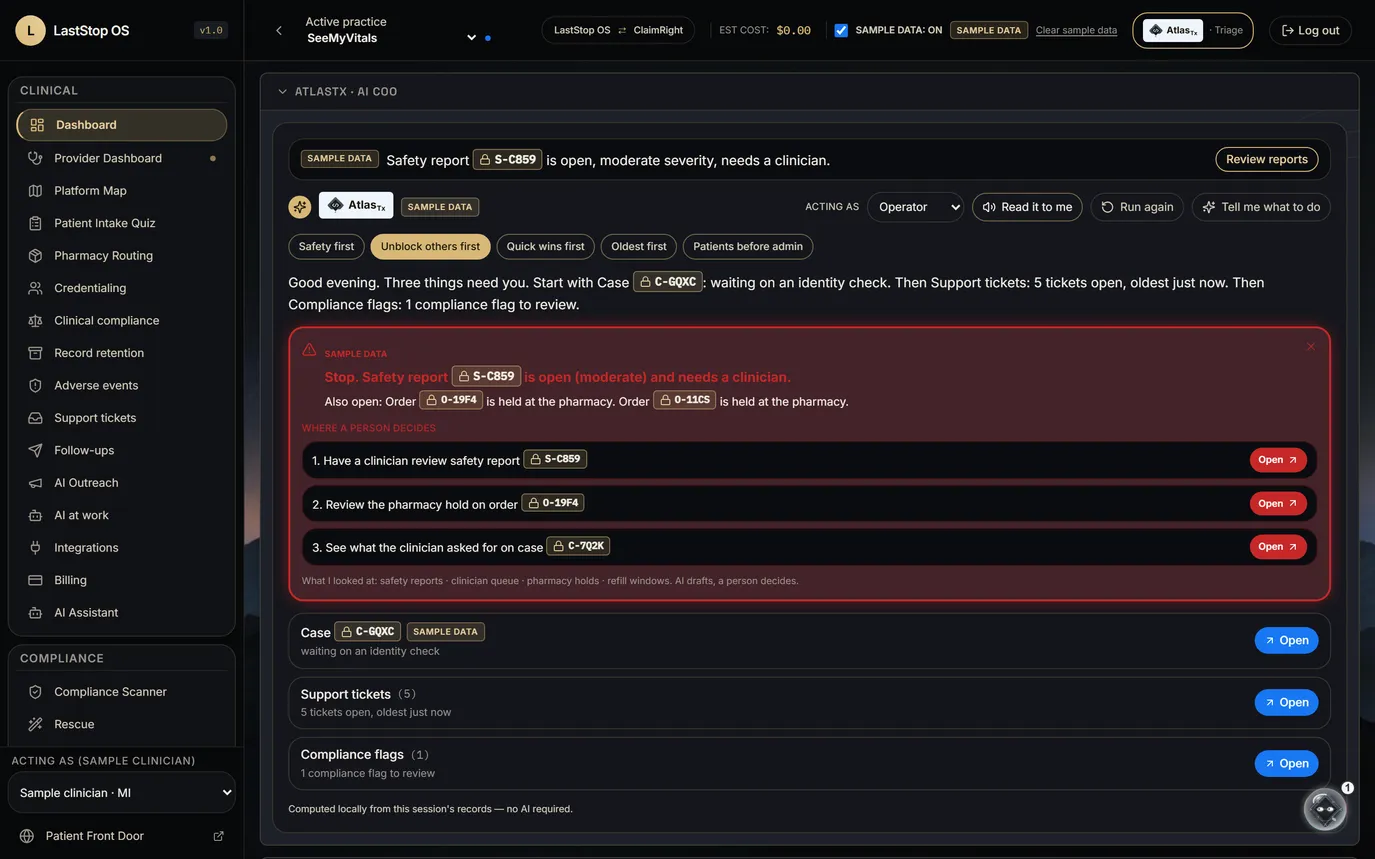
The queue and the fire card
- A one-sentence plan, then the fire card (the worst open safety report and two orders held at the pharmacy), then the ranked queue.
- Five sort orders: Safety first, Unblock others first, Quick wins first, Oldest first, Patients before admin.
- The screen says it: "Ranked by AtlasTx from this session's records."
- Each item opens under "Where a person decides". Clinical items go to a clinician; AtlasTx never decides care.
- On request, "Tell me what to do" asks the AI for a run order and its reasons; a run bar then opens each screen in turn.
Fires first. Then the day, in the order you choose.
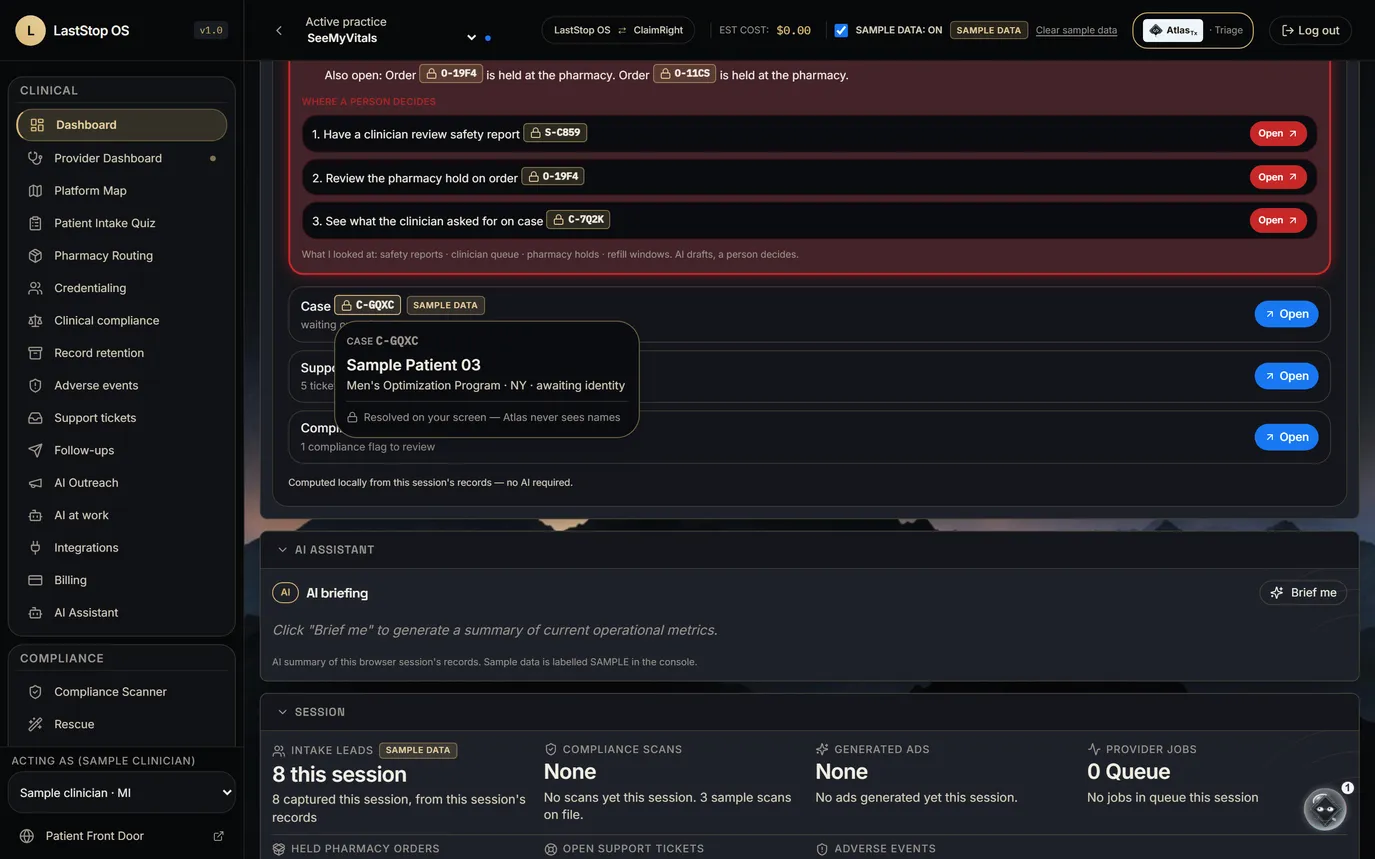
Blind Atlas
- Atlas sees record codes, status codes, queue names, counts and elapsed time. No names, dates of birth, contact details or free text from charts or messages.
- Click a code and the platform draws the person on the signed-in user's screen: "Resolved on your screen — Atlas never sees names."
- Codes are random tokens, never a hash of a name, record number or date. HIPAA allows a re-identification code on those terms (45 CFR 164.514(c)).
- Relative times ("waiting 3 days") replace dates. Chart notes and messages never reach Atlas.
- A guard stops any name, email, date of birth, phone or free-text field from reaching Atlas; 16 automated tests cover the design.
The AI that runs the day never sees who the patients are.
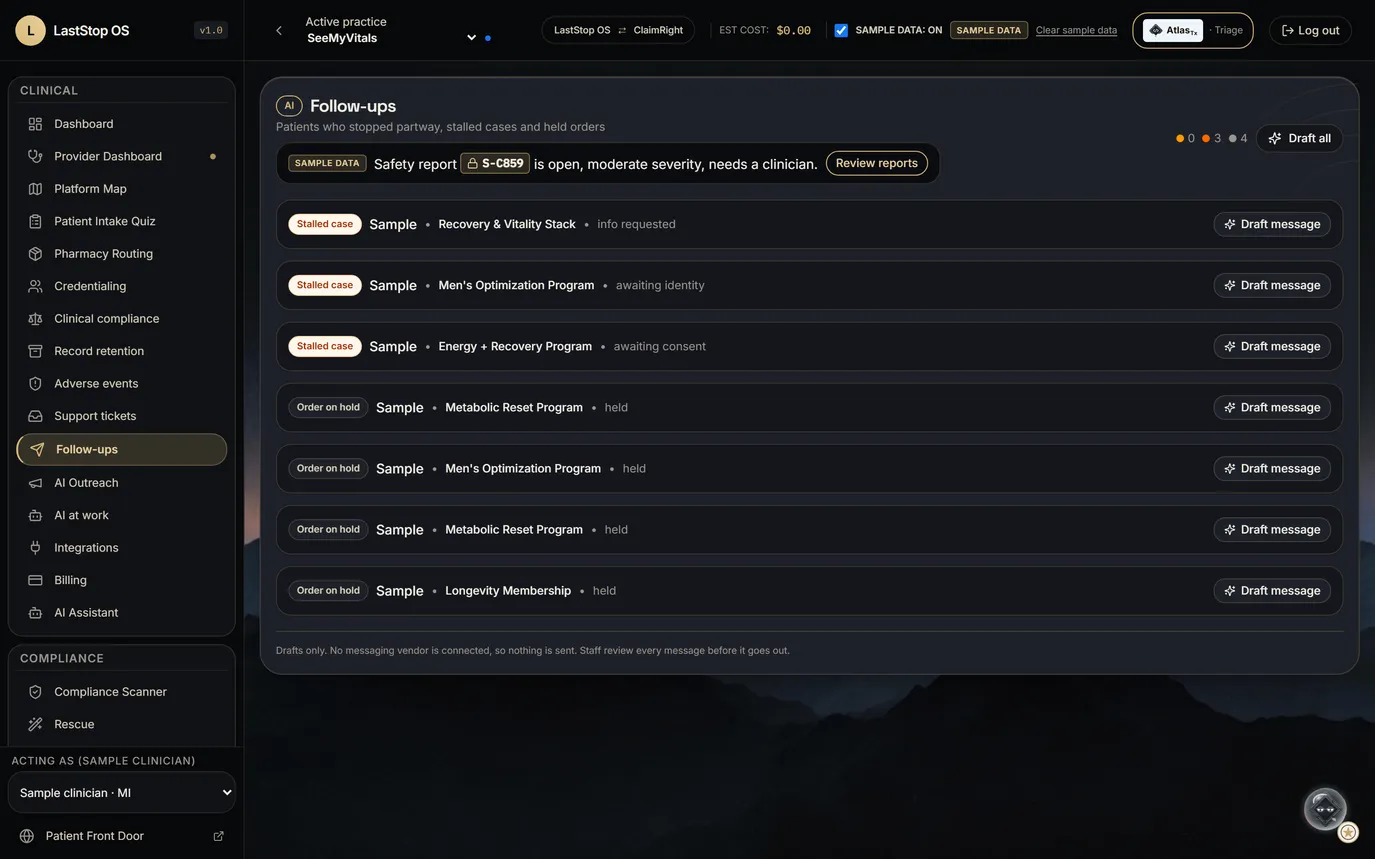
Follow-ups
- Three stalled cases (info requested, awaiting identity, awaiting consent) and four orders on hold, each with "Draft message", or "Draft all".
- The screen says: "Drafts only. No messaging vendor is connected, so nothing is sent."
- A person approves, edits or discards each draft.
- Sending starts when a messaging provider and carrier registration (10DLC) are in place.
Every stalled case and held order, with the message already drafted.
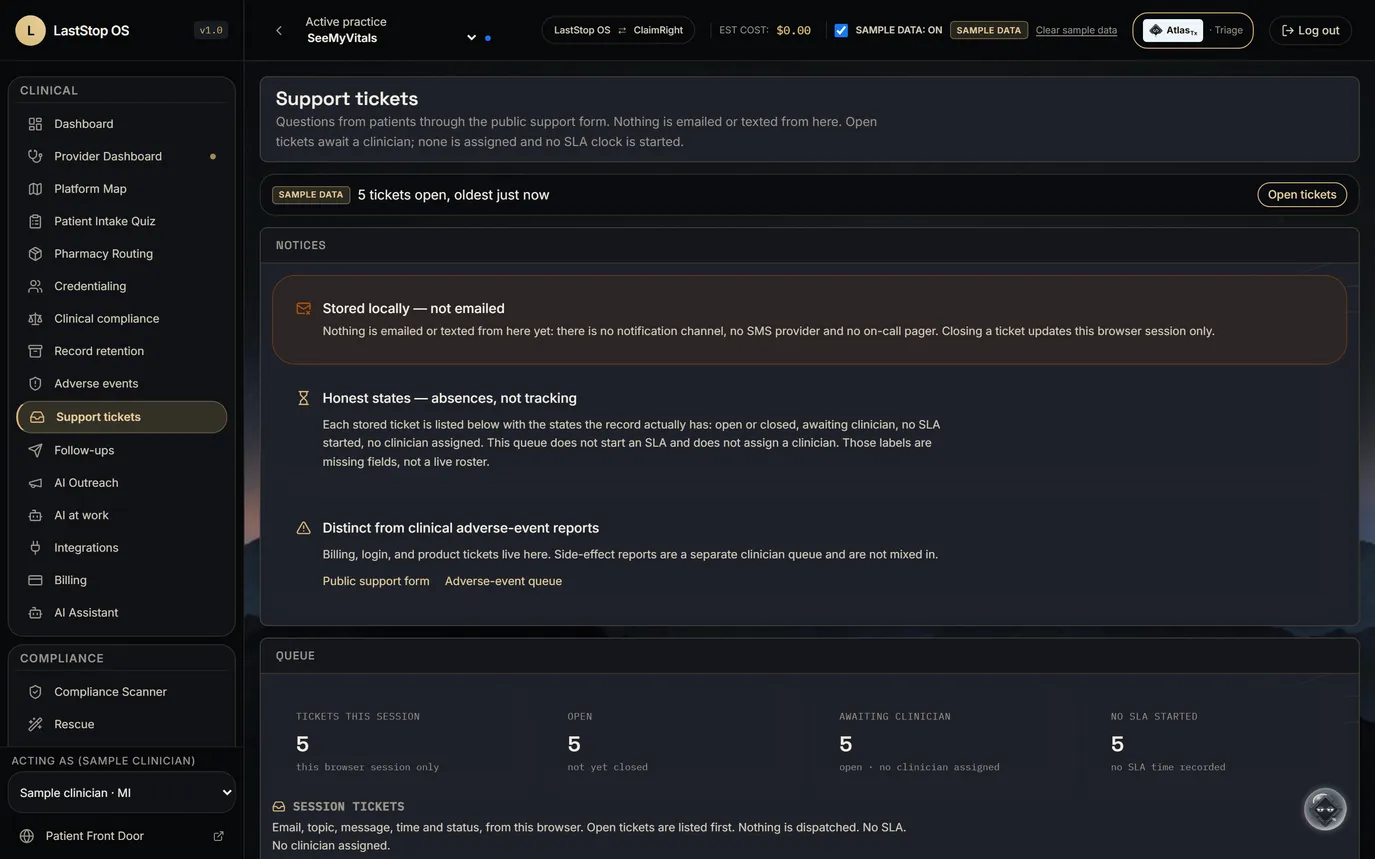
Support tickets
- Billing, login and product questions live here. Side-effect reports go to a separate clinician queue and are never mixed in.
- AI drafts an urgency read and a suggested reply for each open ticket; a person reads, edits and sends.
- On the side-effect queue, AI suggests a severity; a clinician confirms every escalation.
- Honest states on screen: no SLA started, no clinician assigned, nothing emailed or texted yet.
Patient questions in one queue, side effects in another, each with a drafted reply.
The platform
LastStop, the framework
One platform, many practices, each with its own brand.
- The framework: intake, cases, both clinical setups, the pharmacy, the patient portal, billing, audit and integrations.
- Staff sign in first, then choose the practice, so one platform can run several practices.
- Each practice gets its own brand kit and separated data. The separation is built in the engine, which is not hosted yet.
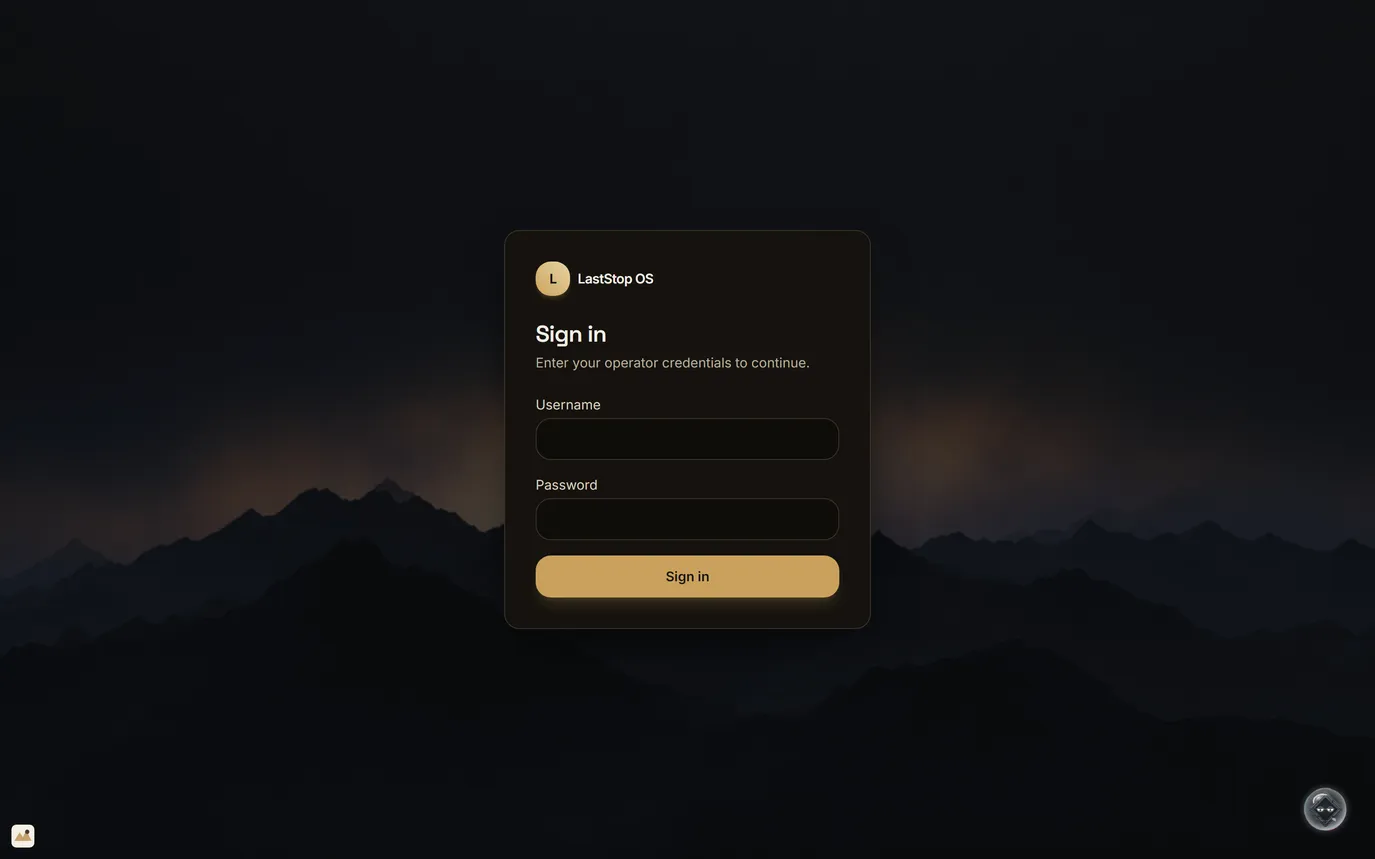
- The demo signs in with shared preview logins. Per-staff accounts, roles and MFA are built in the engine and get wired in before launch.
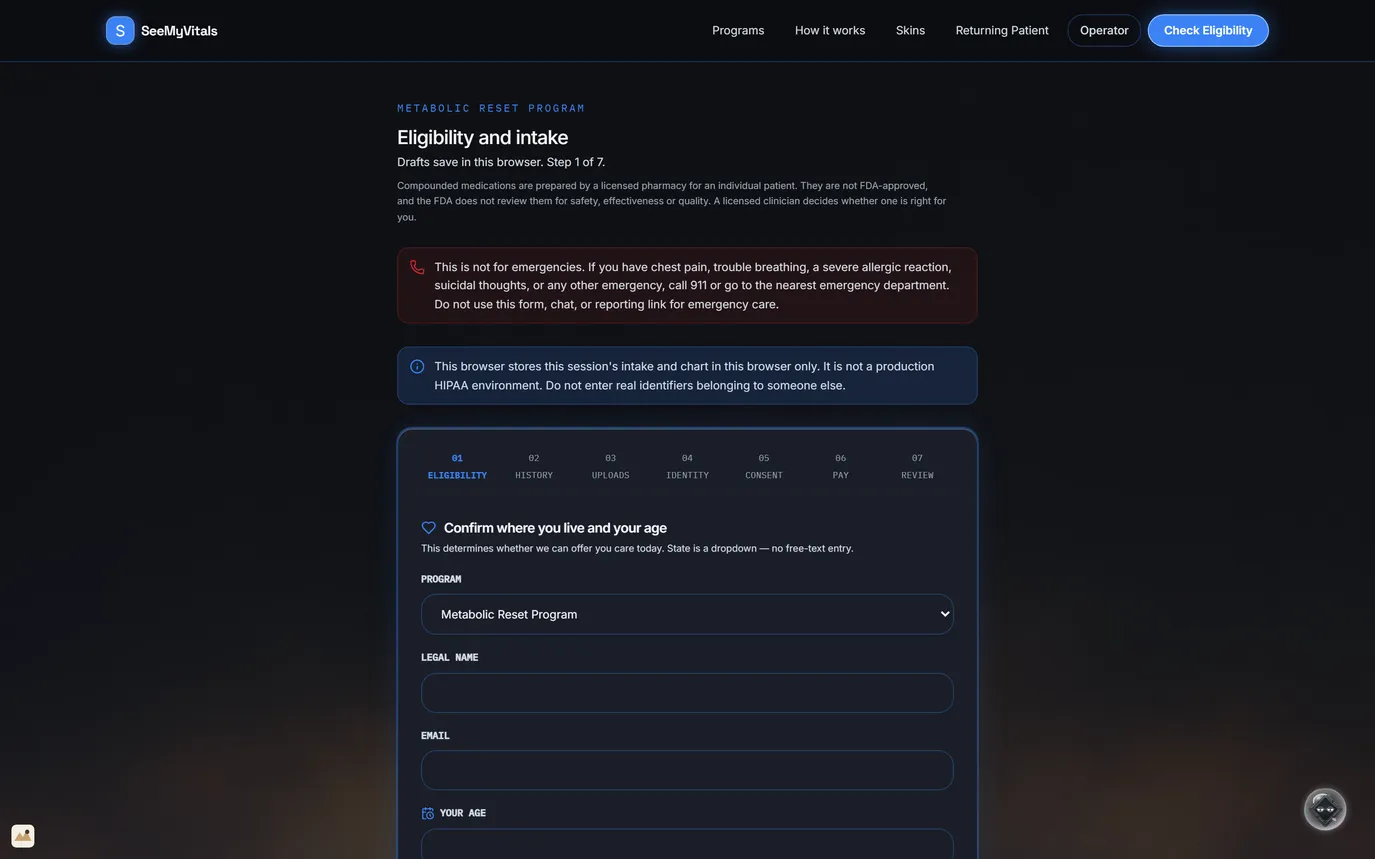
Patient intake
- Seven steps: eligibility, history, uploads, identity, consent, payment, review.
- Step 1 checks the program, age, state of residence and physical location at the time of the visit. Licensure follows the physical location, not the billing address.
- State is a dropdown, not free text.
- The compounded-medication disclosure sits at the top of the form.
- The fields are empty in this capture; test runs use fictional values. Staff review IDs by hand until an identity vendor is connected.
Eligibility is settled on the form, before a clinician opens the case.
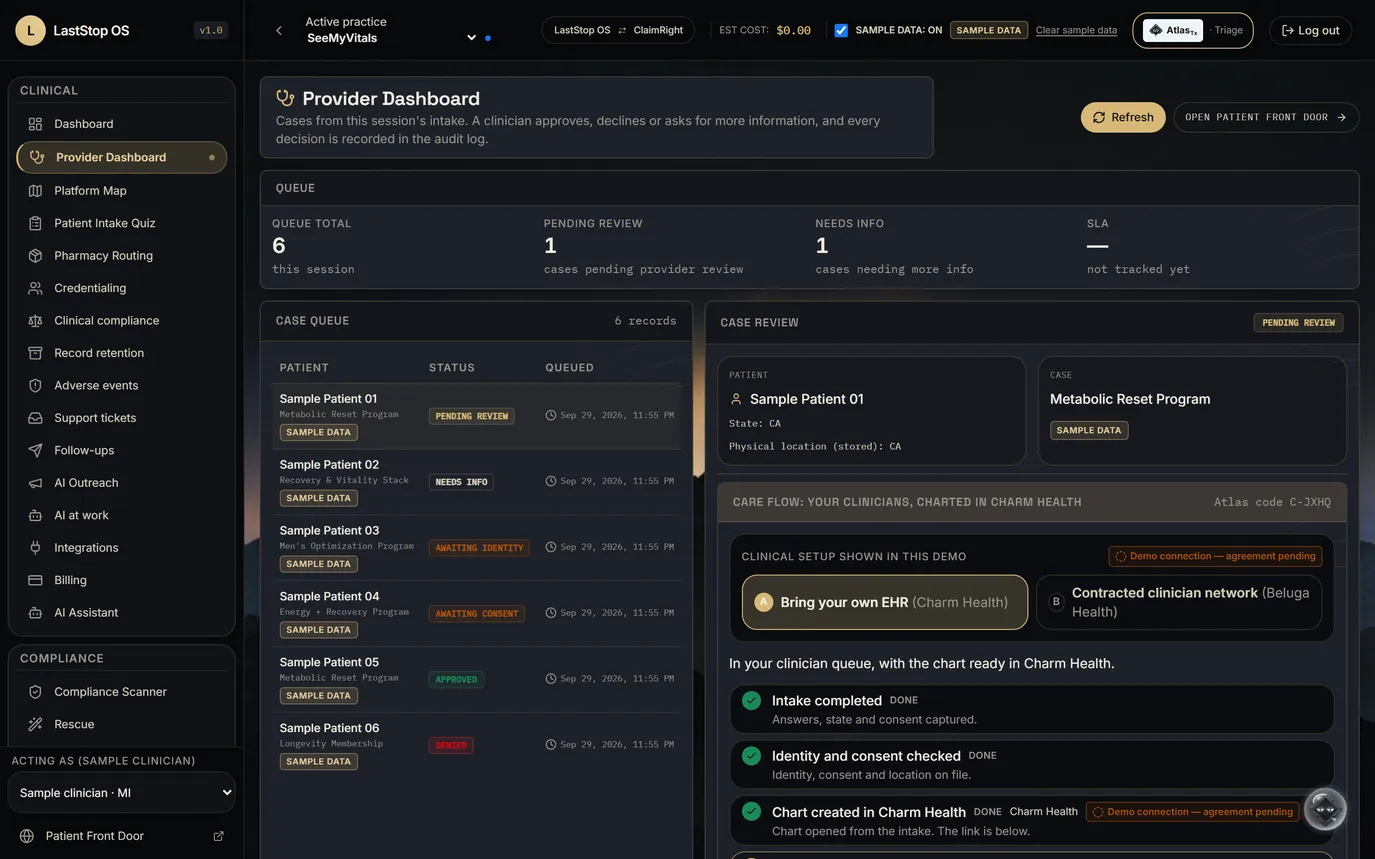
The case queue
- Six sample cases: pending review, needs info, awaiting identity, awaiting consent, approved, denied.
- A rules pre-chart summarises program, flags, hard stops and payment type from a fixed template.
- An AI pre-chart drafts a plain-English summary, watch-outs and visit questions from a de-identified case summary.
- The care-flow panel shows which clinical setup the practice runs.
- A licensed clinician approves, declines or asks for more information; each decision goes to the audit log.
Every finished intake arrives as a case a clinician can act on.
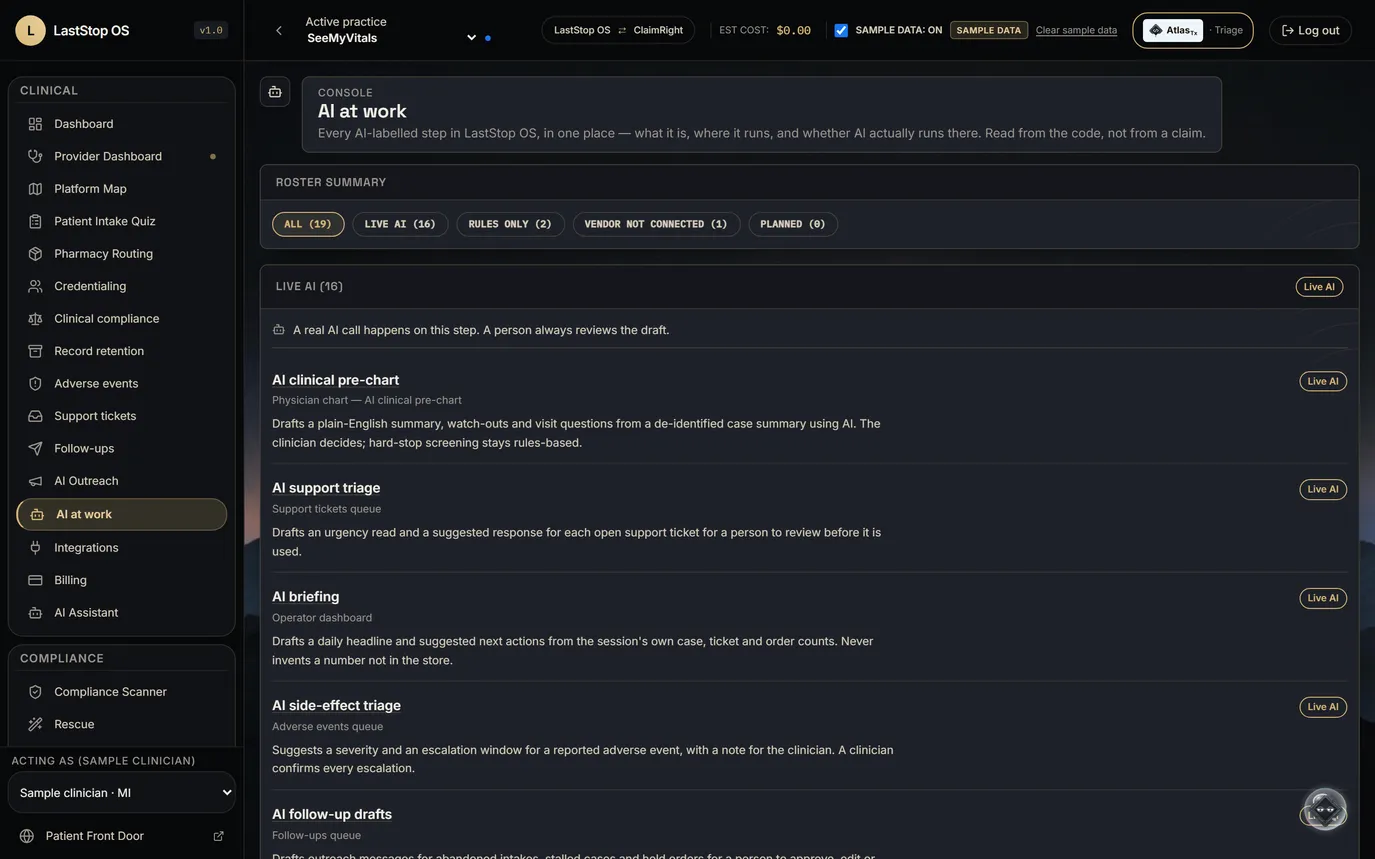
AI at work
- The list is generated from the code, not written by hand. It is the same list behind the AI badges on each screen.
- Each step shows where it runs and what it does.
- AI steps draft, sort or explain. None sends, spends or prescribes.
- AI calls carry de-identified summaries or record codes, never a patient's name.
Every AI step in the product, listed from the code.
Integrations
Integrations 1 · Bring your own EHR
For example, Charm Health.
Your clinicians keep charting where they already chart.
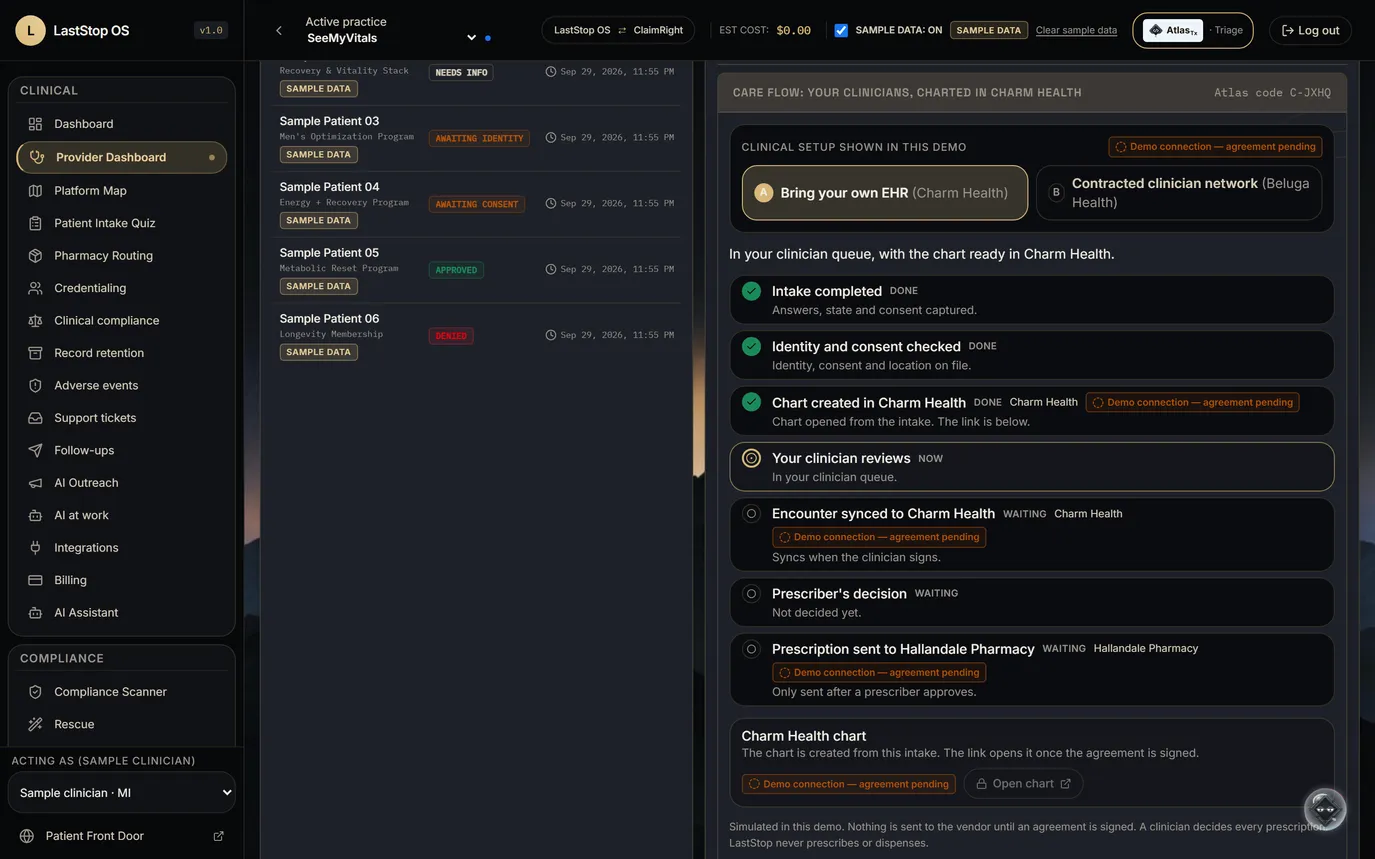
- For a practice with its own clinicians: the chart is created in Charm Health from the intake, your clinician reviews, and the encounter syncs back.
- Only an approved prescription moves on to the pharmacy.
- Charm Health publishes REST and FHIR R4 APIs; the LastStop connector is planned.
- Simulated in this demo. Nothing is sent to Charm Health.
Integrations 2 · Contracted clinician network: Beluga Health
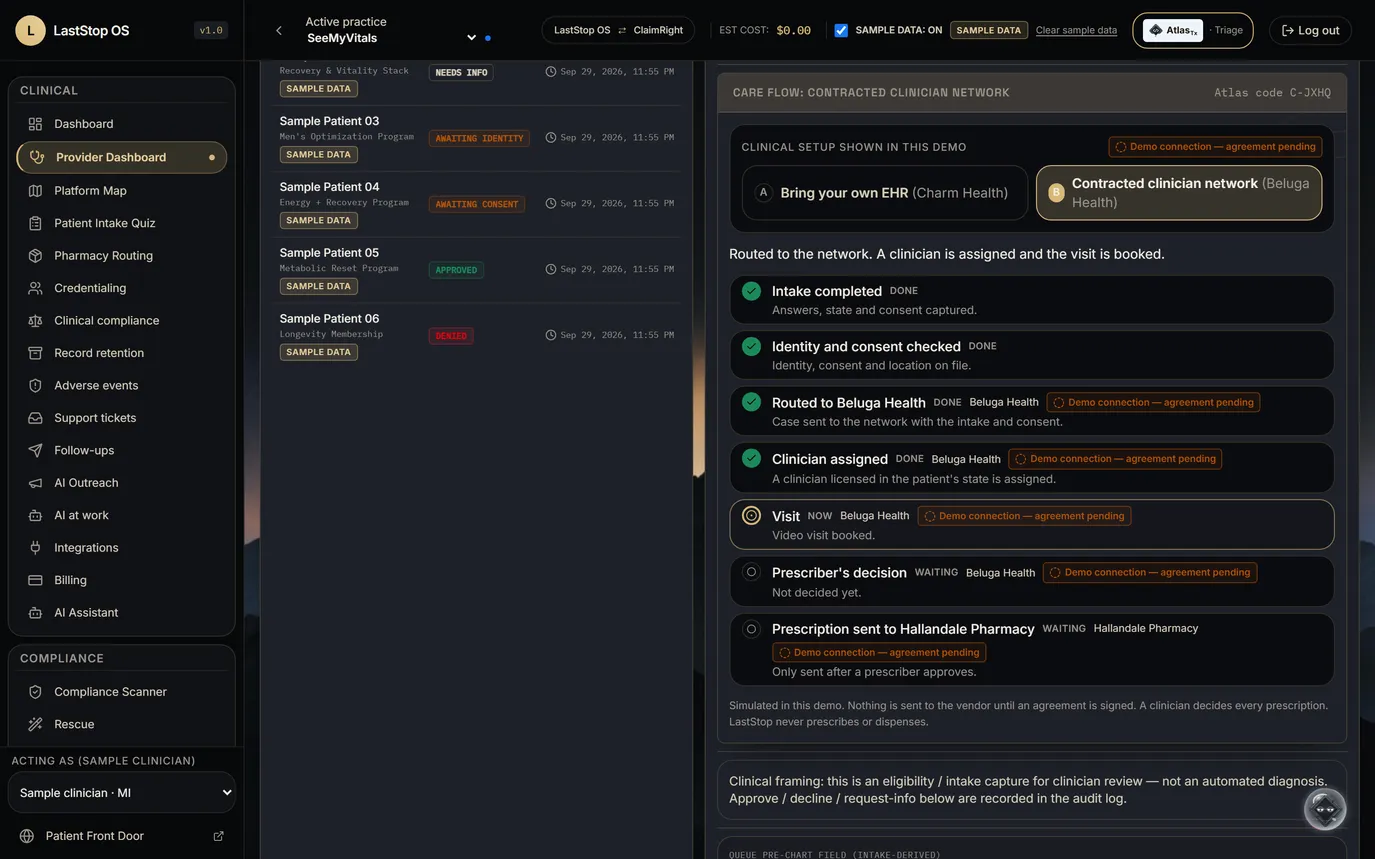
- The case goes to the network with the intake and consent; a clinician licensed in the patient's state is assigned and a video visit is booked.
- E-prescribing, PDMP checks and EPCS are the network's responsibility, not LastStop's.
- Built in the engine: a Beluga Health simulator, and a live connector that refuses to run until an agreement is signed.
- OpenLoop and Wheel are built the same way, as alternatives.
No clinicians on staff? A licensed network sees the patient in their state.
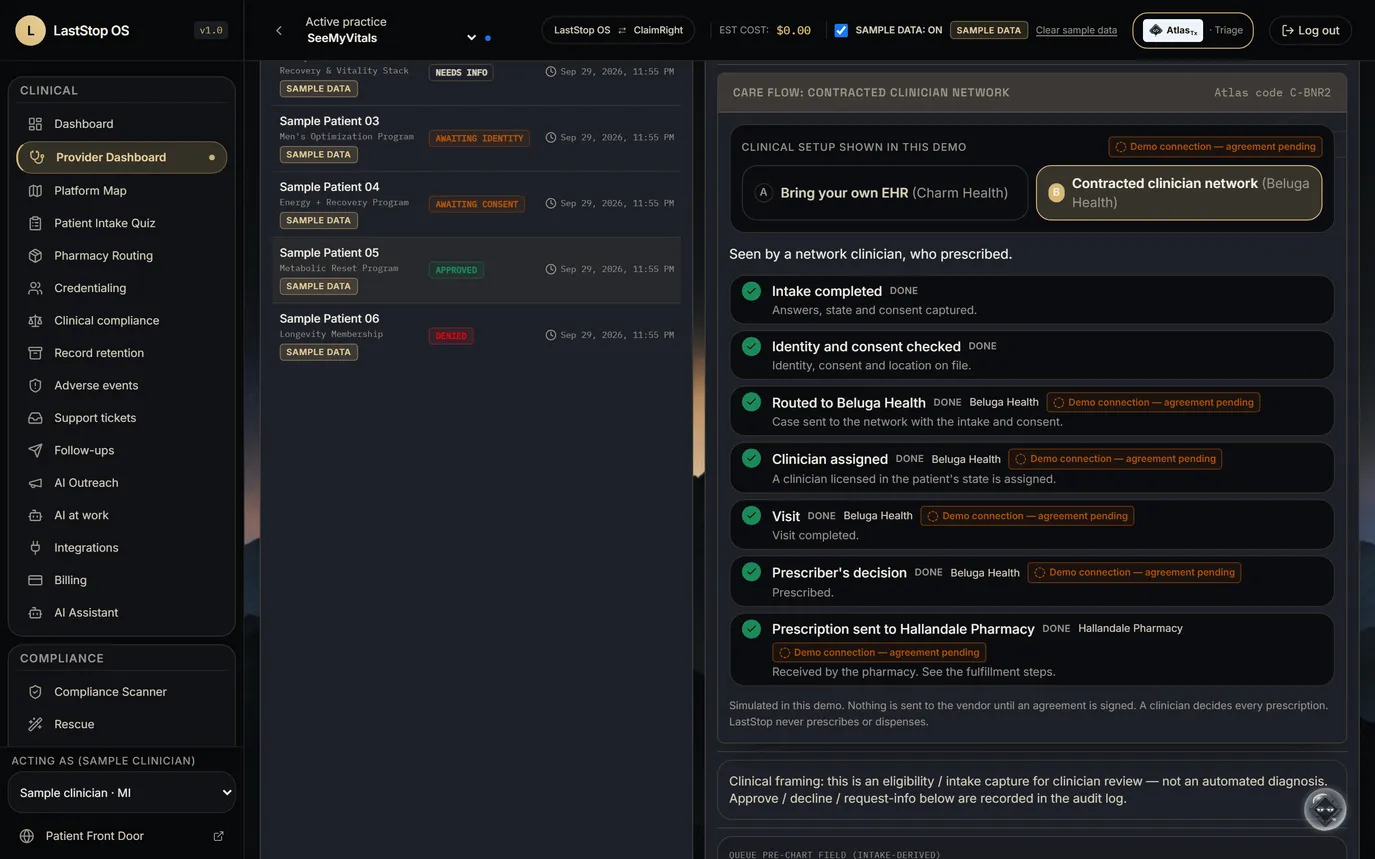
Seen, prescribed, sent
- Intake, identity and consent, routed to Beluga Health, clinician assigned, visit completed, prescribed, received by Hallandale Pharmacy.
- The screen states it: "A clinician decides every prescription. LastStop never prescribes or dispenses."
- The pharmacist verifies and compounds.
- Simulated in this demo; nothing is sent until an agreement is signed.
One approved case, from intake to the pharmacy, on one screen.
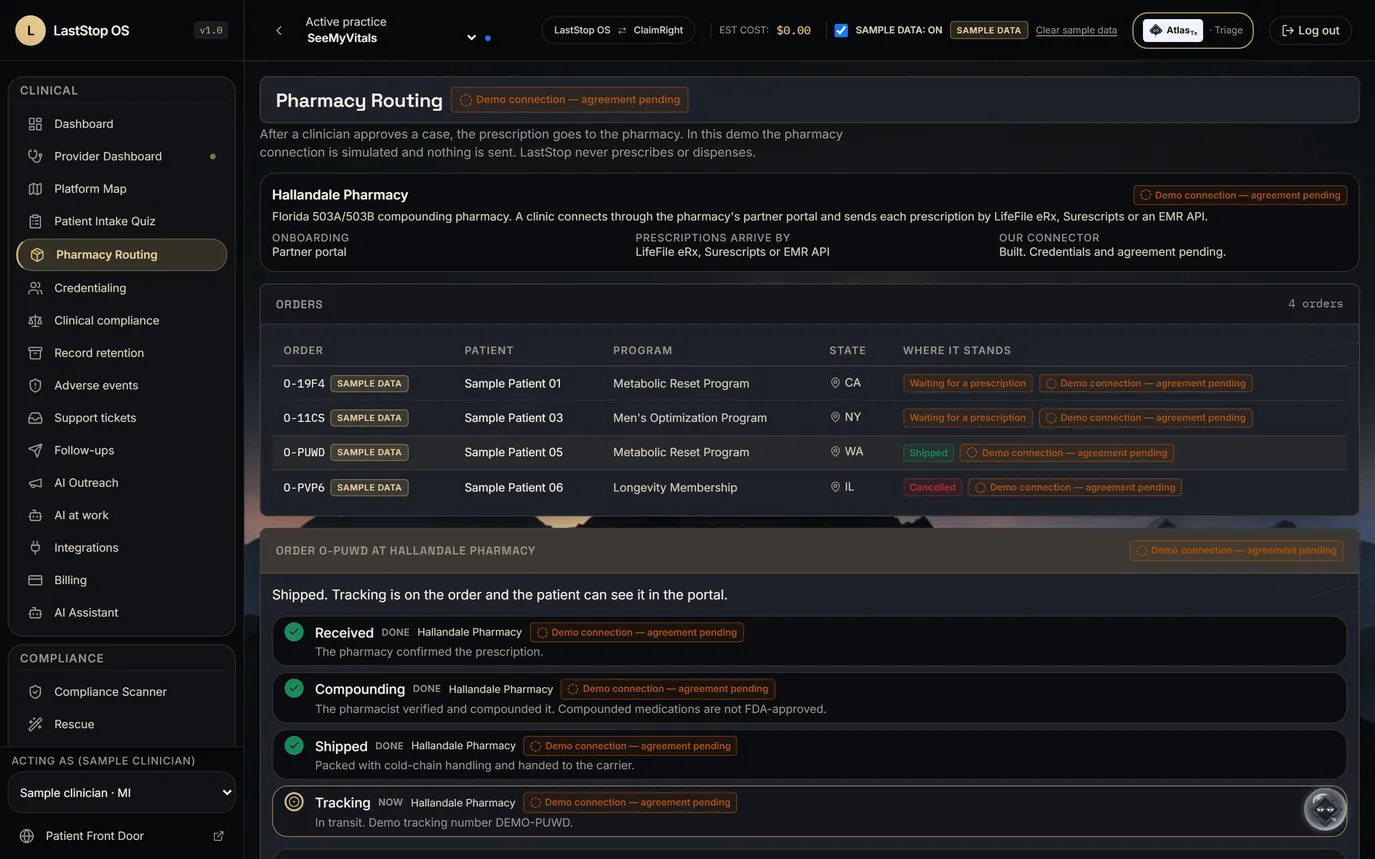
Integrations 3 · Hallandale Pharmacy
- Hallandale is a Florida 503A/503B compounding pharmacy. A clinic onboards through its partner portal and sends each prescription by LifeFile eRx, Surescripts or an EMR API.
- Four sample orders: two waiting for a prescription, one shipped, one cancelled.
- Until a pharmacy is connected, every approved case creates a held order instead of being routed.
- The LastStop connector is code-complete in the engine; credentials and the agreement are pending.
- Five more compounding pharmacies are planned on the same pharmacy interface.
Approved prescriptions go to the pharmacy. Nothing unapproved can.
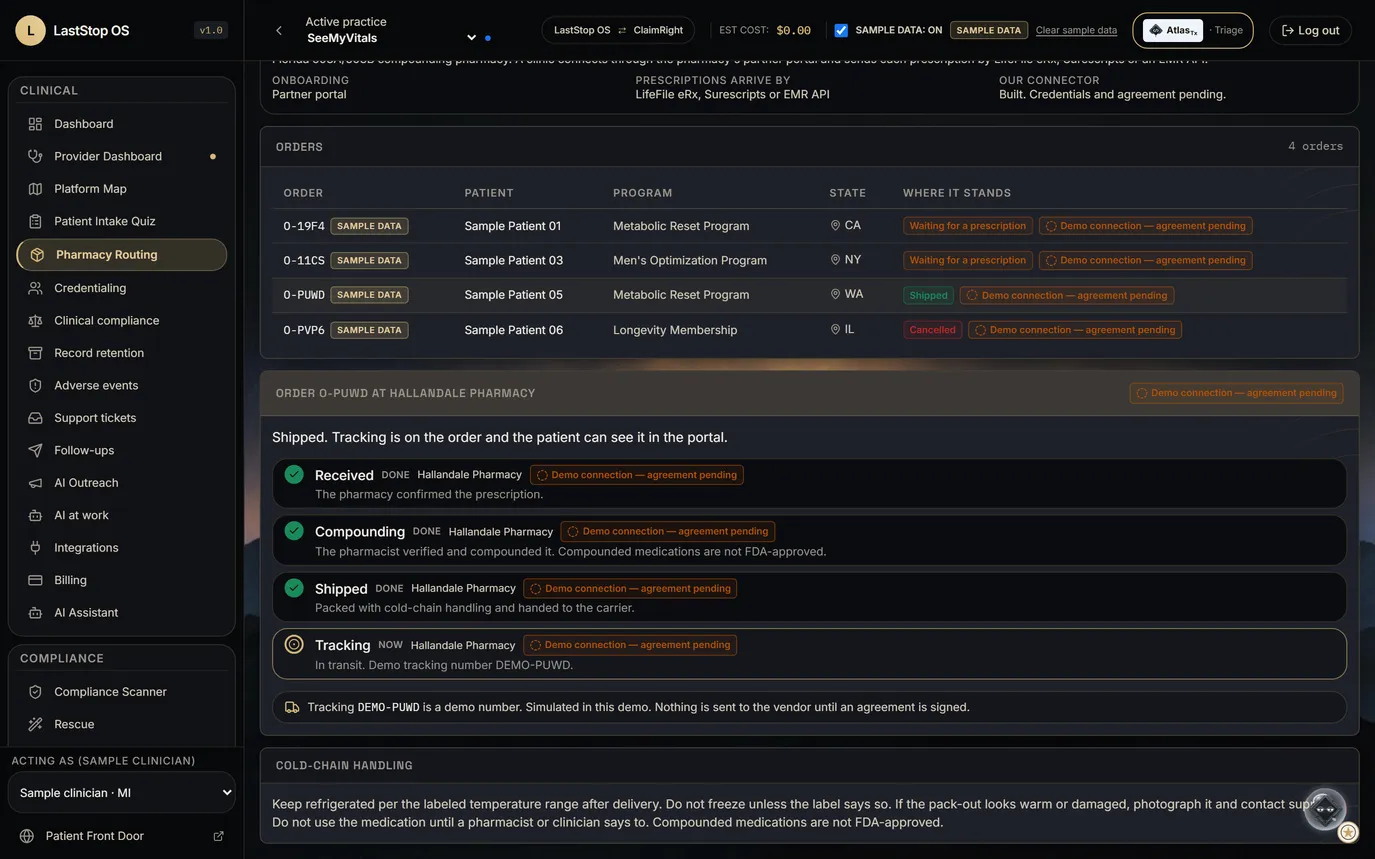
Fulfilment and tracking
- Order O-PUWD: prescription confirmed, compounded, shipped with cold-chain handling, tracking on the order.
- DEMO-PUWD is a labelled demo tracking number.
- The step states: "Compounded medications are not FDA-approved."
- Real tracking arrives with the pharmacy agreement and a shipping integration (planned).
Pharmacy status flows back to the order and to the patient's portal.
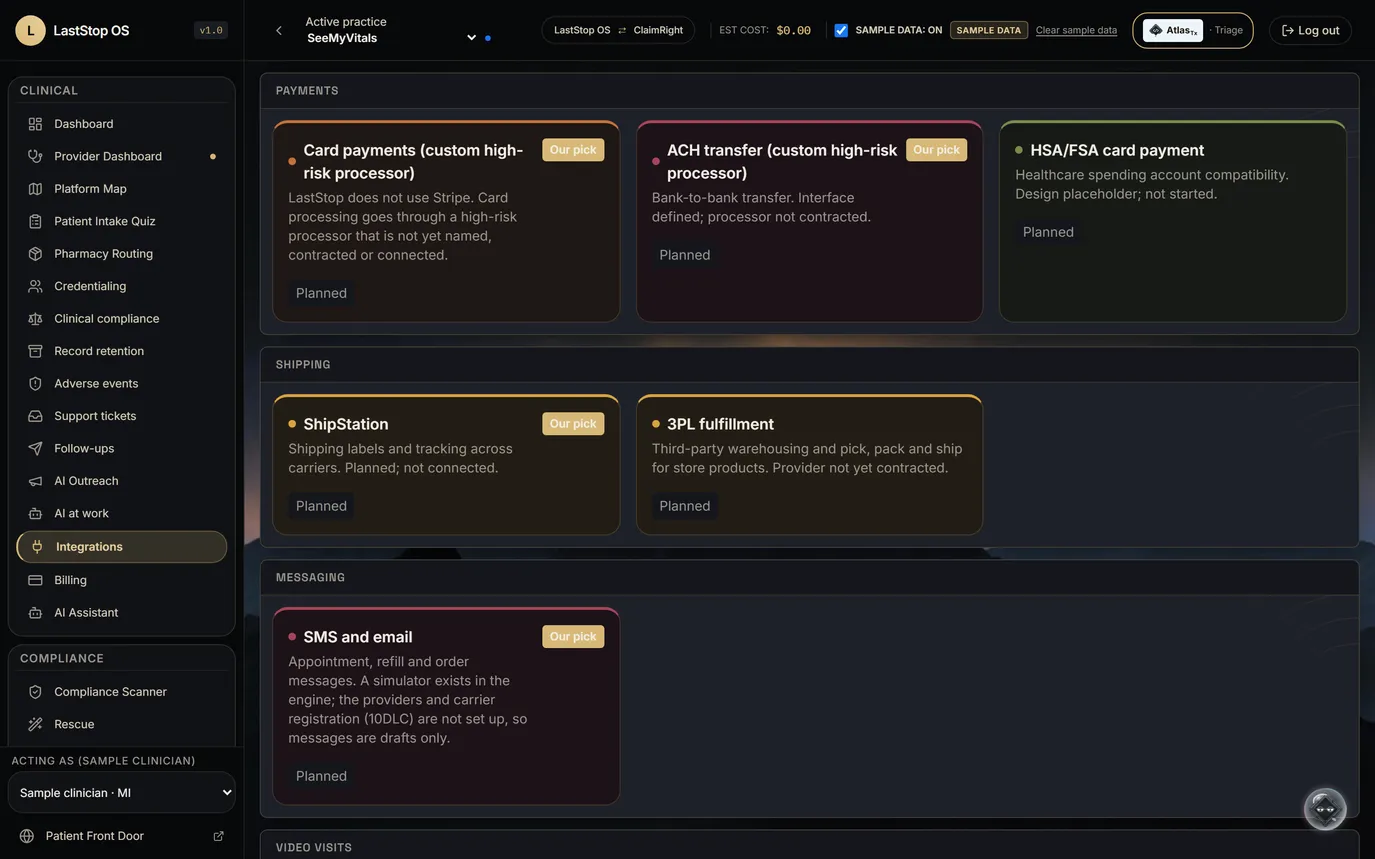
Integrations 4 · Payment processing
- Card and bank (ACH) payments go through one processor, not yet named or contracted. The platform does not use Stripe.
- Built in the engine, not yet hosted: card authorize and capture, refunds, subscriptions and dunning.
- Until the processor is connected, the patient portal shows no plan price, no card on file and no invoices. Nothing is invented.
- Refunds, payment holds and chargebacks stay with a person.
Charging, refunds and renewals are built. The processor isn't signed yet.
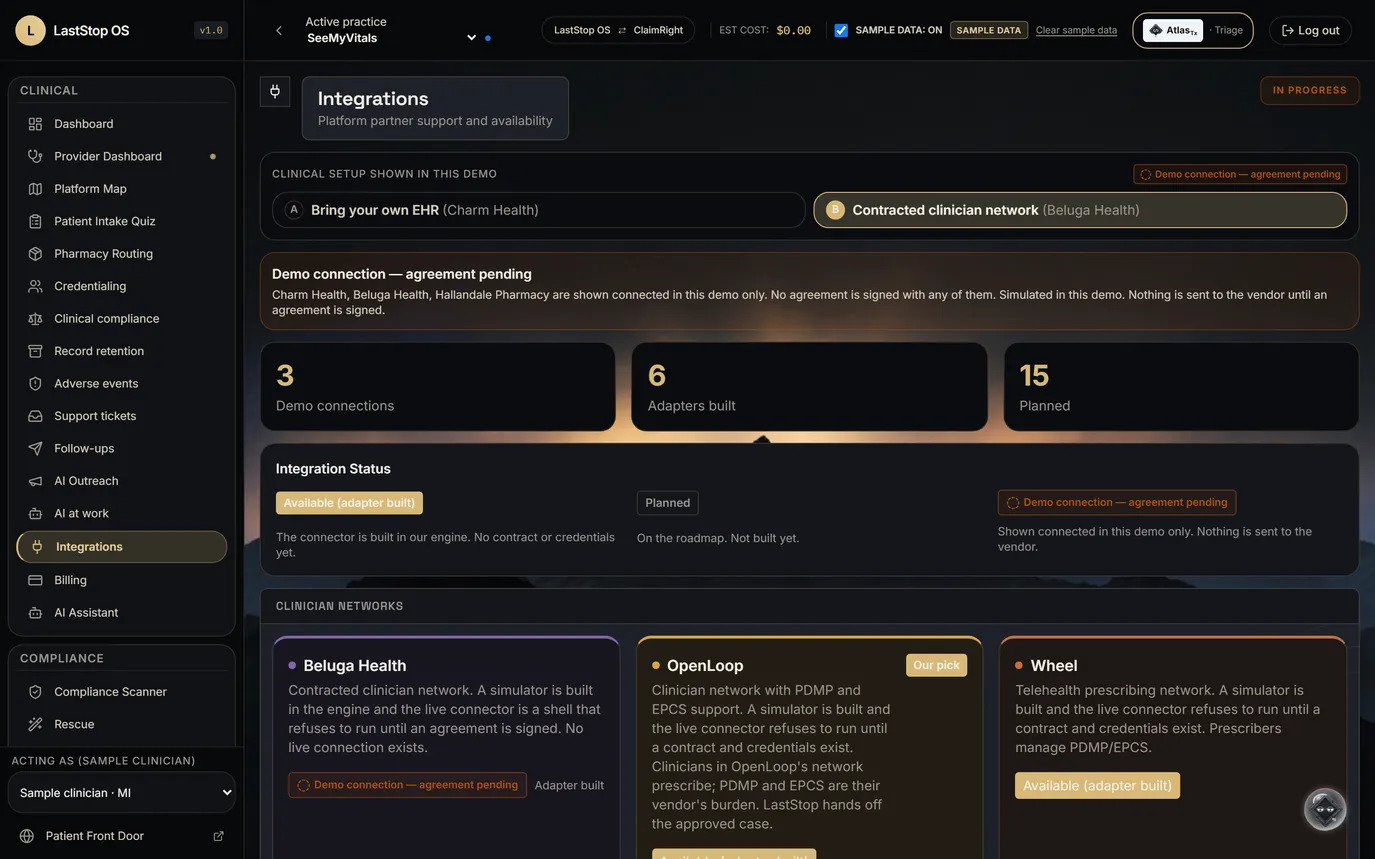
Integrations 5 · The full catalog
- Categories: clinician networks, EHR, pharmacies, payments, shipping, messaging, video visits, identity verification and labs.
- Adapters built in the engine: Beluga Health, OpenLoop, Wheel, Healthie, Hallandale Pharmacy and the video-visit connector. None has a contract or credentials yet.
- "Demo connection" means shown connected in this demo only, with the agreement pending.
- Messaging (SMS and email) is planned. Until a provider and carrier registration exist, every message is a draft.
- The page is read from the same catalog the platform uses.
21 partners, 9 categories, and an honest status on every card.
Growth Engine
Growth Engine
Brand, ads and outreach from one kit, checked before anything runs.
- Brand Absorber reads a site into a brand kit; Style Absorber borrows a look without the identity.
- Ad Studio builds finished ads in 7 formats from pre-approved messages, in the practice's locked Seasons.
- Outreach bots draft messages for four patient segments. Nothing sends without a person.
- Every ad and message runs through the claim rules before a person sees it.
Brand Absorber
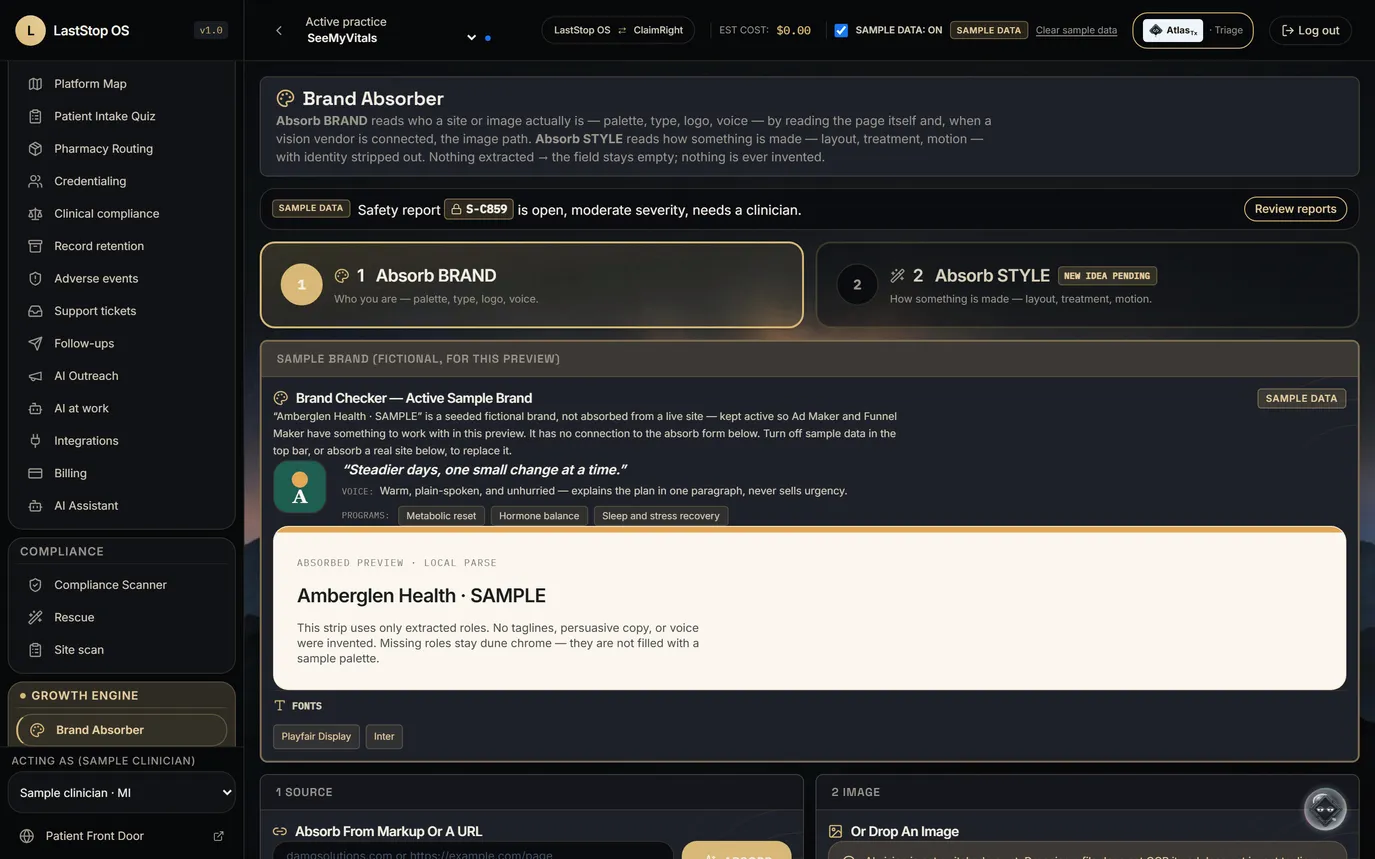
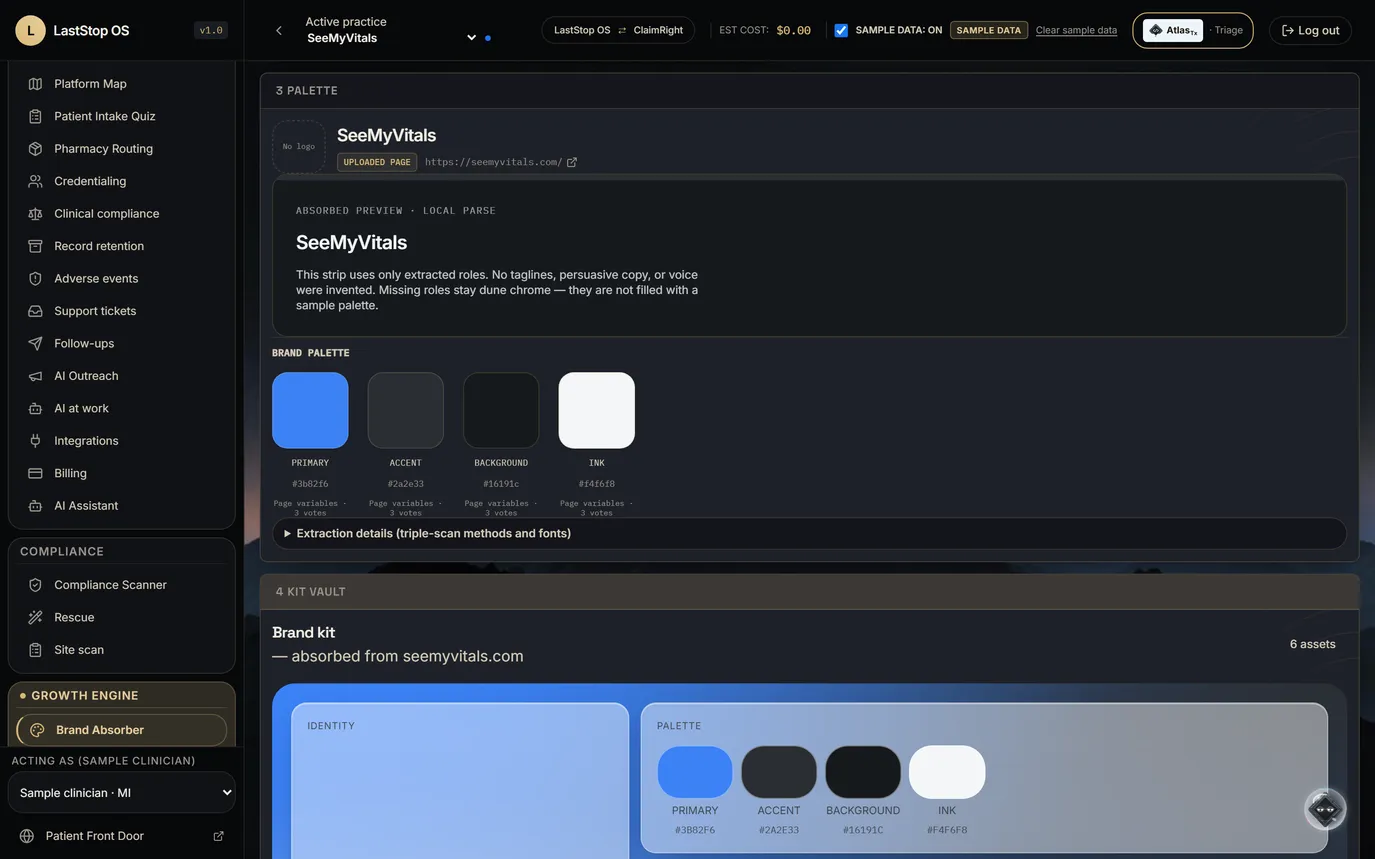
- Reads a site's palette, fonts and logo into the brand kit. An HTML upload works too.
- Every ad, page and message after that draws from the kit.
- One of the platform's live functions: it runs in the product today, not only in the demo.
- A person reviews and edits the kit before it is used.
Paste your site's address. Get your brand kit: colors, fonts, logo.
Style Absorber
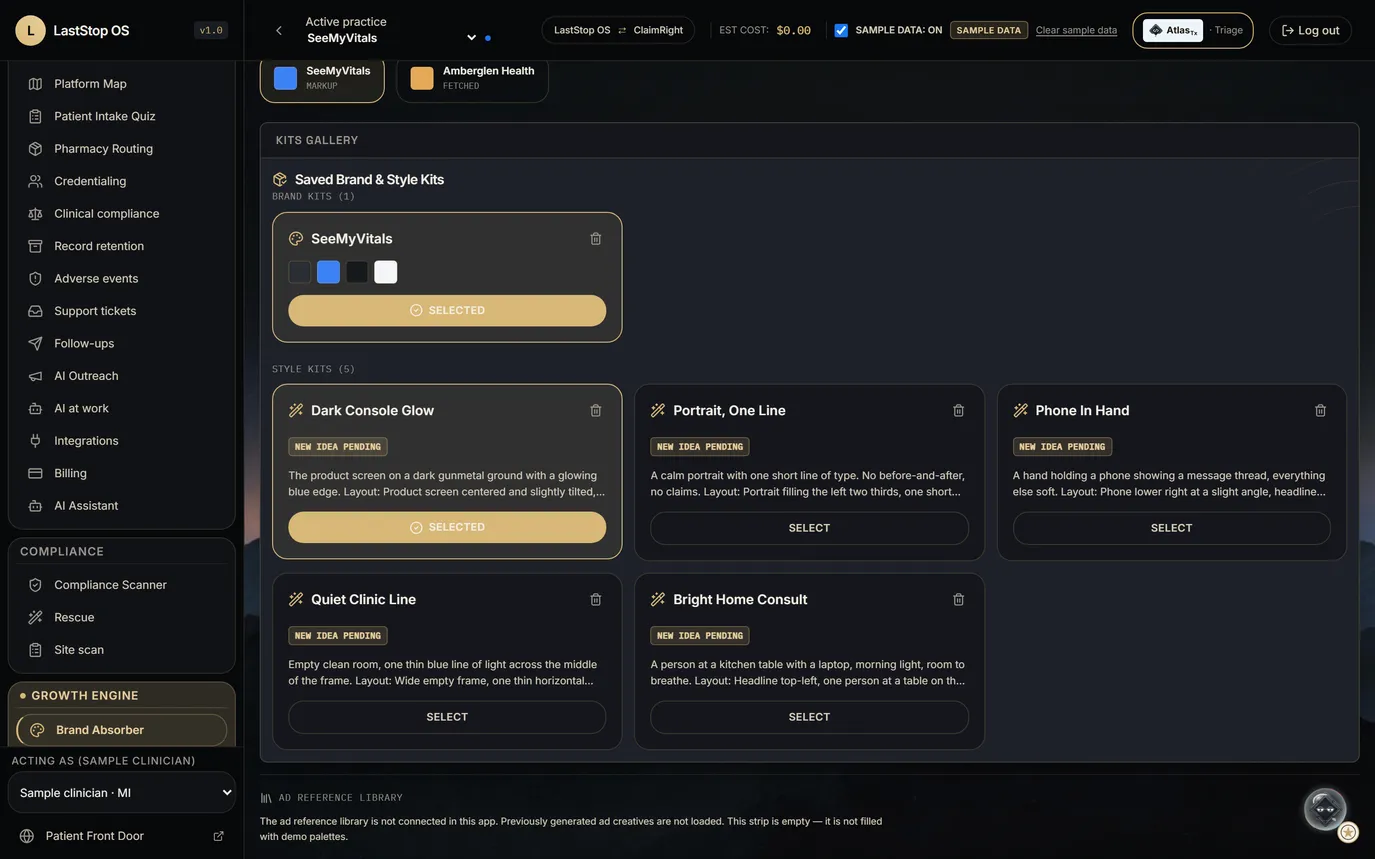
- Rebranded? New style? Want to test a look, or learn from one that's working for someone else?
- Upload a screenshot or give a page address. It extracts a style kit: layout, composition, type treatment, color treatment, photography, motion and copy approach.
- It never carries identity: no logos, company or product names, copy text or exact color values. A check refuses any kit that leaks a hex color code.
- If the page has no preview image, it fails honestly instead of guessing.
- The product labels it "New idea pending".
Borrow the look. Never the brand.
Ad Studio, telehealth mode
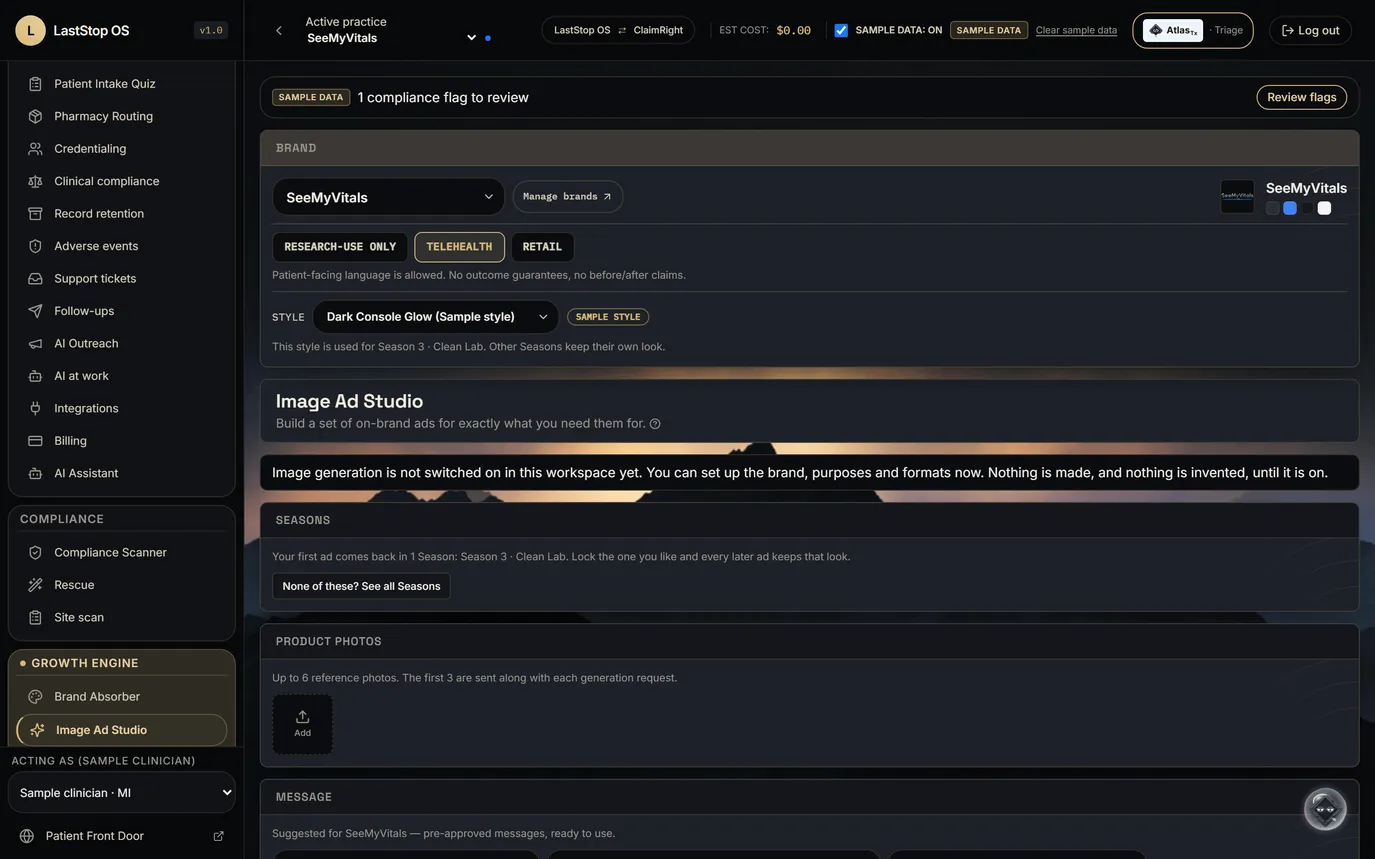
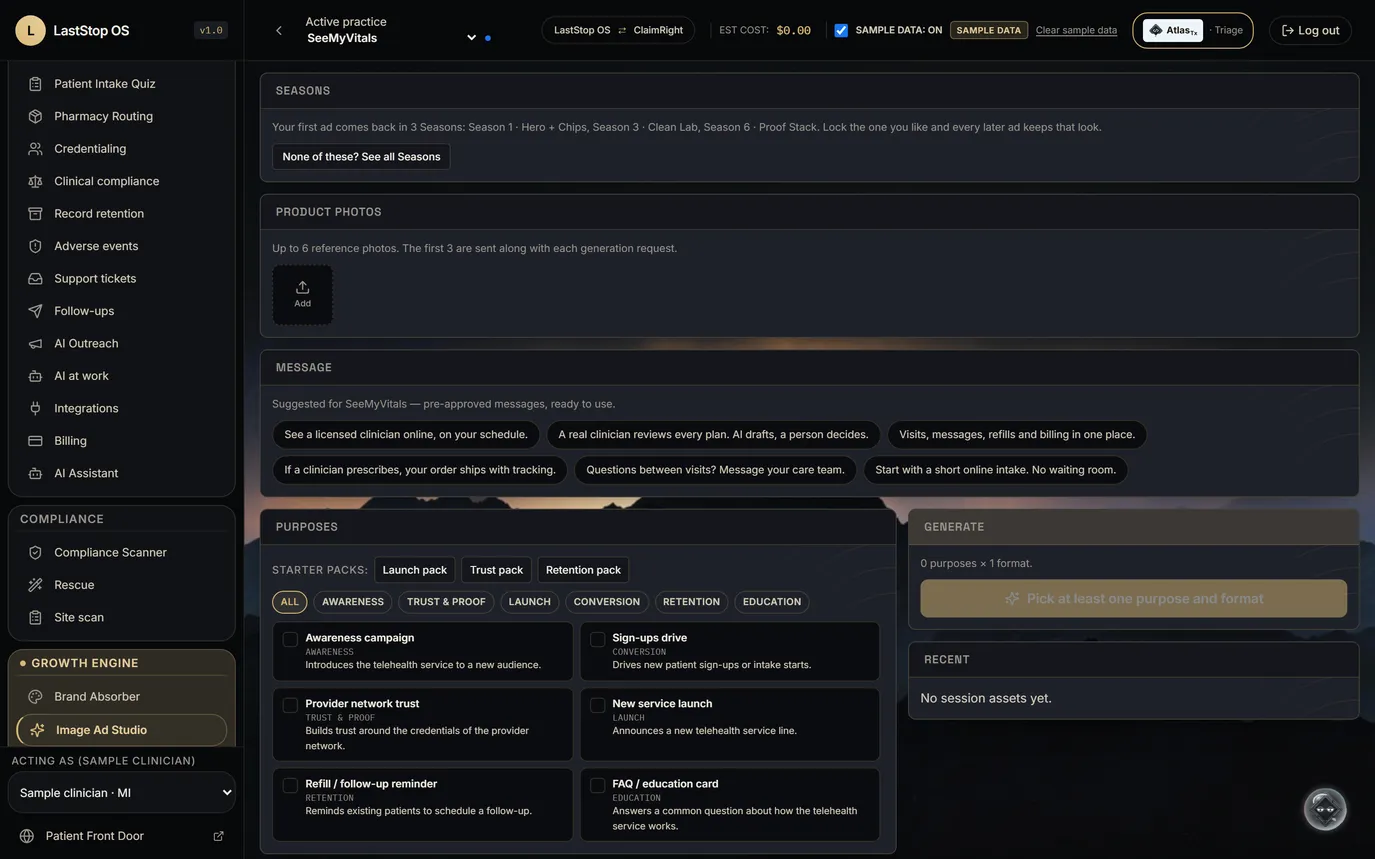
- Telehealth mode allows patient-facing language. Outcome guarantees and before-and-after claims are not allowed.
- Six pre-approved messages for SeeMyVitals, for example "A real clinician reviews every plan. AI drafts, a person decides."
- Formats: feed 1:1, feed 4:5, Stories and Reels 9:16, display 16:9, email header, web hero, product card.
- Logo, call to action and required lines are always set by code.
- In this demo workspace the page says plainly that image generation is not switched on. It is on in other LastStop workspaces.
Ads built only from messages you've pre-approved, in every size you run.
Seasons
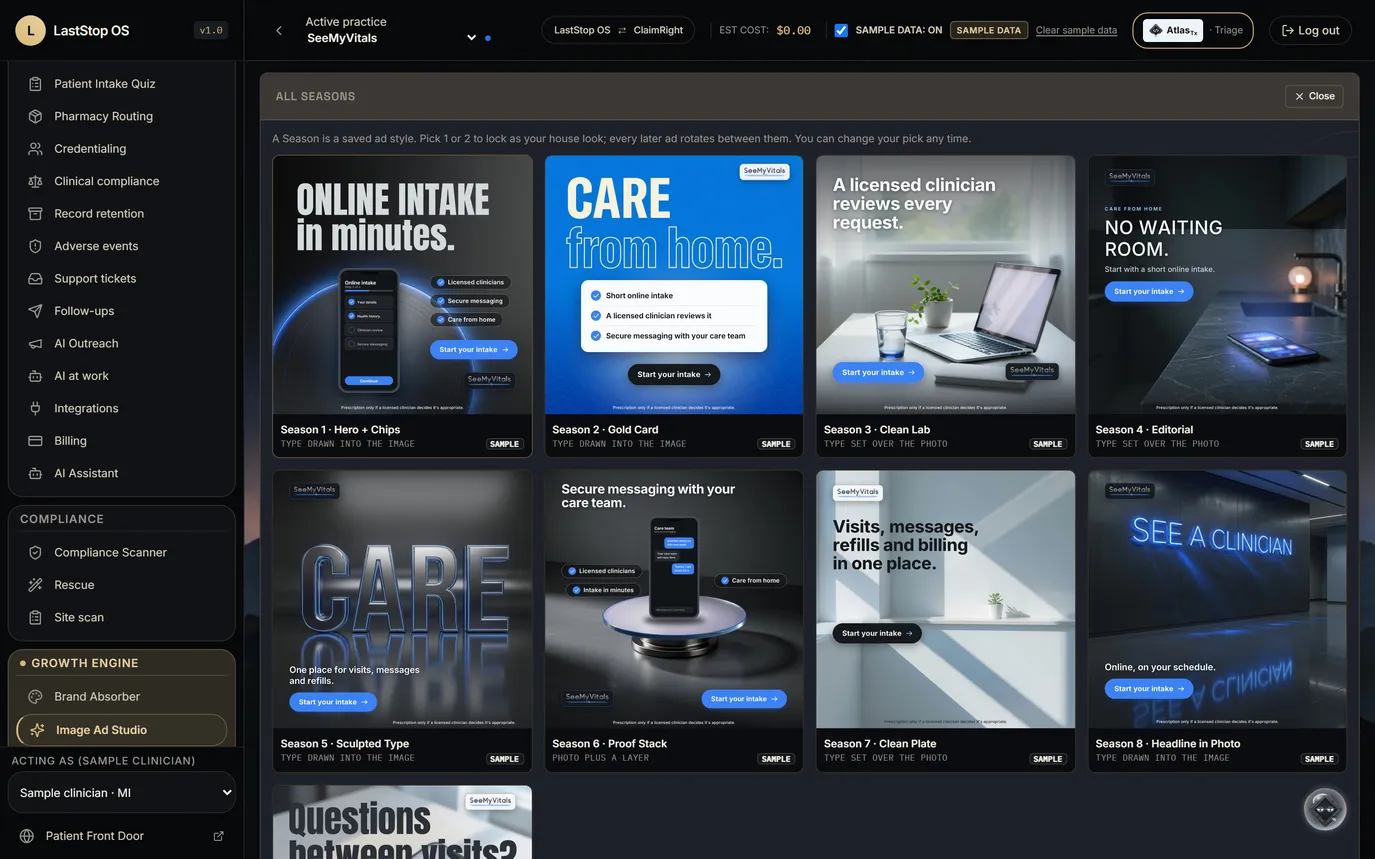
- A Season is a saved, versioned ad recipe. Nine are active in the gallery.
- The first ad arrives in three Seasons. "None of these?" opens the gallery of finished samples, each labelled SAMPLE.
- Lock one or two Seasons as the house look; later ads rotate between them. "Surprise me" is still there.
- Every ad records the Season and version it came from, so a good ad can be traced and made again.
- When the image model draws a headline, a text reader checks it: one retry on a mismatch, then set type. A misspelled ad is never shown as finished.
Pick a house look once. Every ad after that stays on it.
Draft rules · need clinician and counsel sign-off
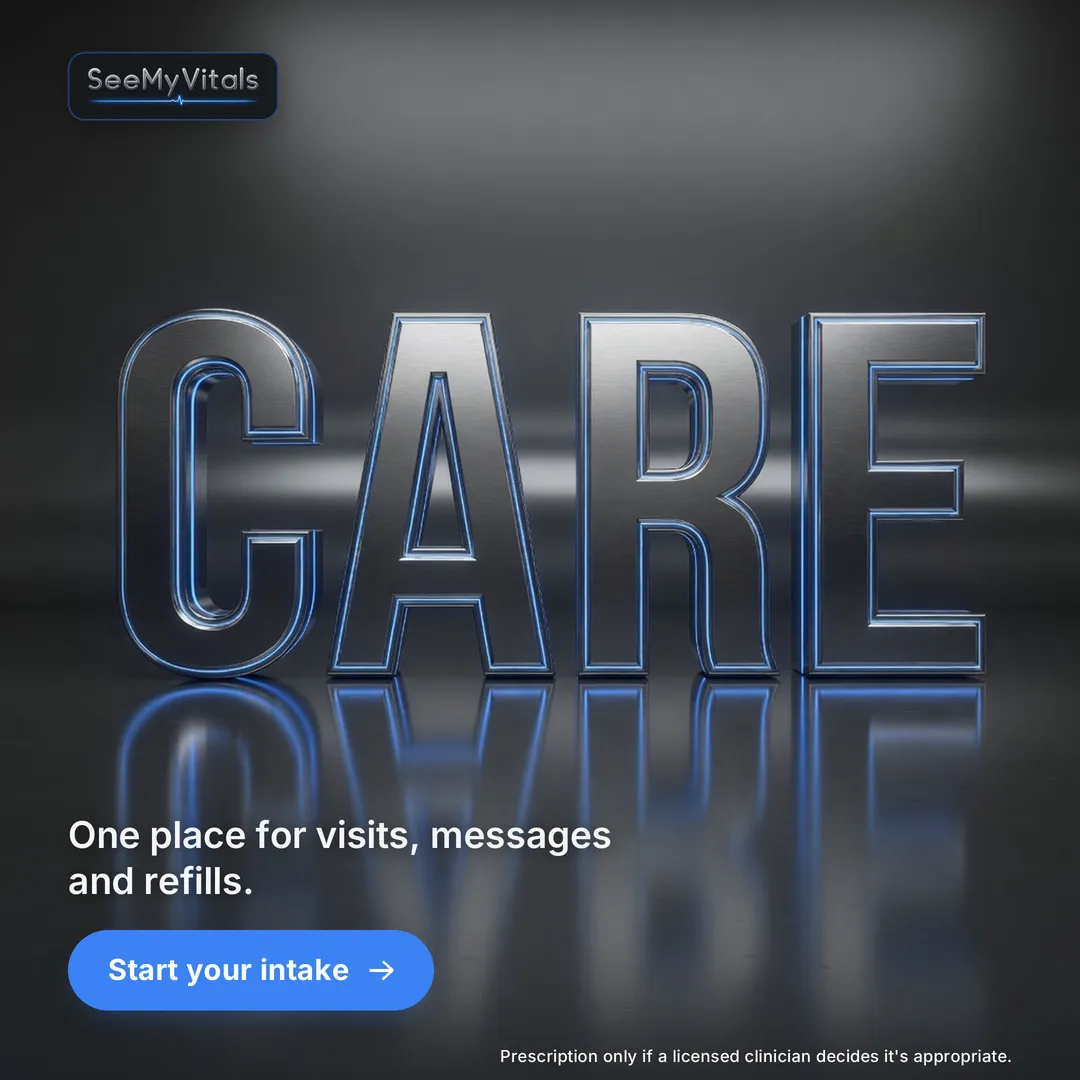
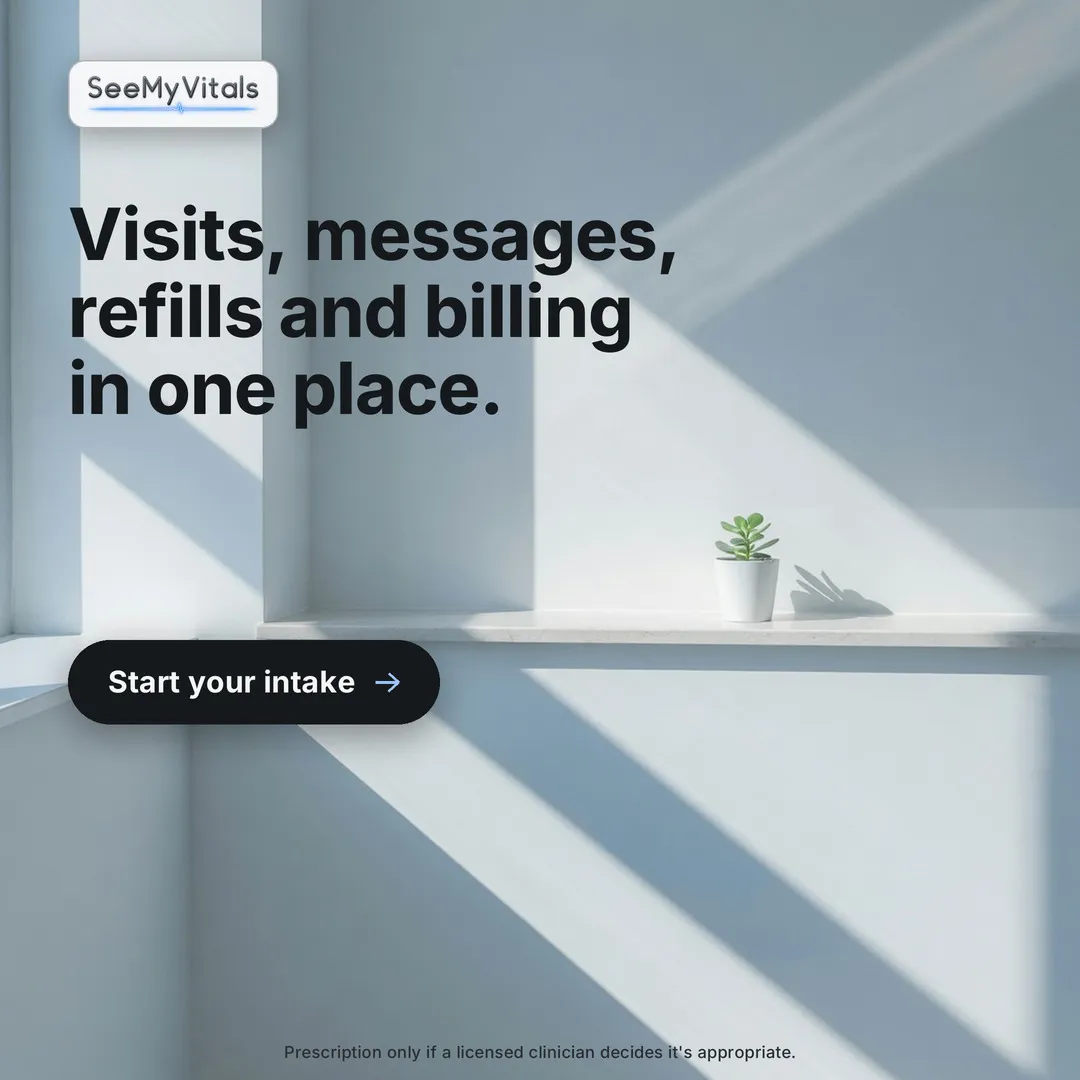
What the Seasons look like
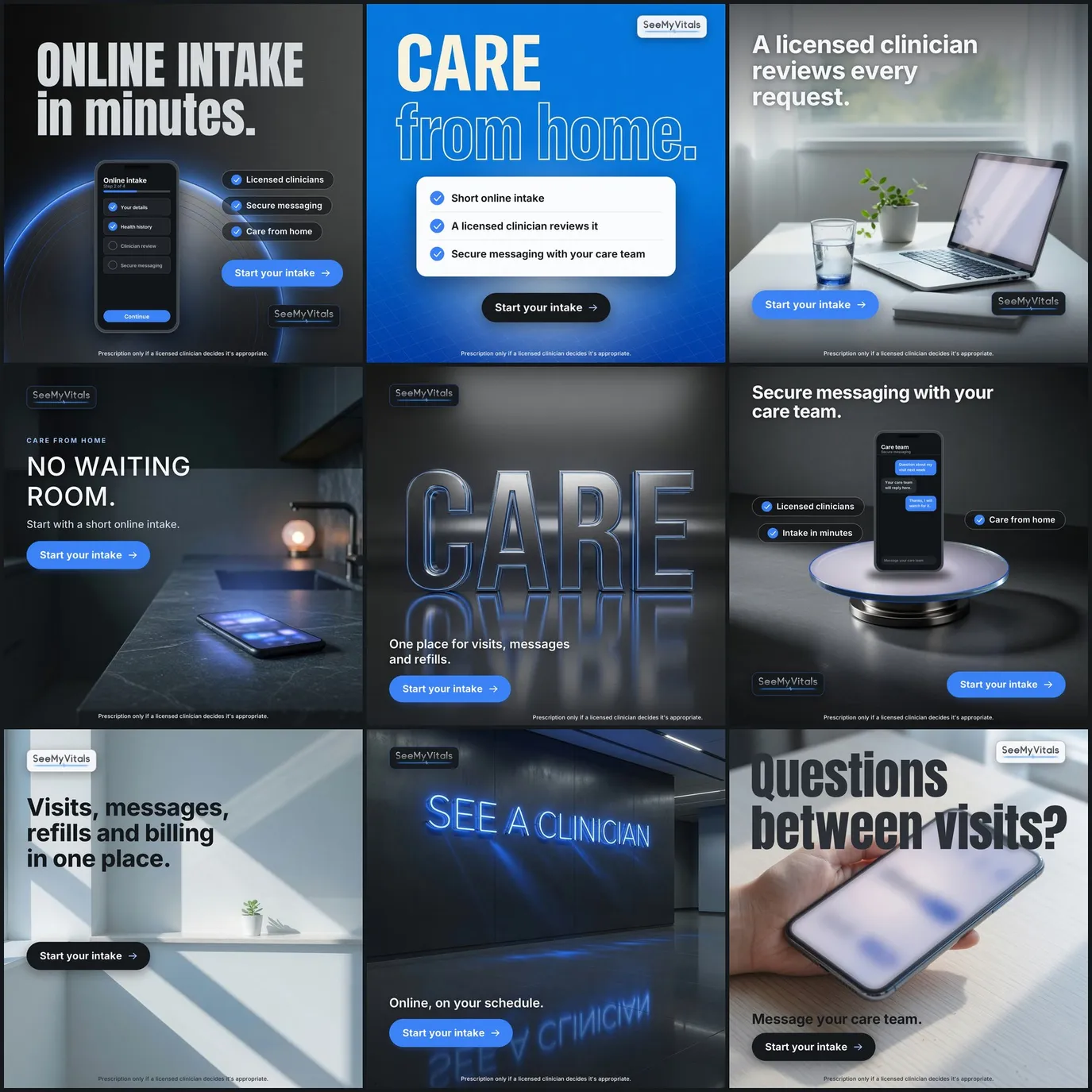
- Sample ads made outside this demo workspace: pictures from an image model, words, logo and required lines set by code. Labelled SAMPLE in the app's Season gallery; none has run as an ad.
- One sample per Season, in the owner's order. Right: Season 5, Sculpted Type, and Season 7, Clean Plate.
- Every word the image model drew was read back letter by letter. The phone screens in Seasons 1 and 6 are drawn by code, not screenshots of the app.
- No outcome, weight-loss or “guaranteed” claims, no drug names, no before-and-after bodies. The prescription line is on every ad, and every copy set passes the app's own telehealth copy check.
Nine Season looks, one sample ad each. Made outside this demo workspace, labelled SAMPLE.
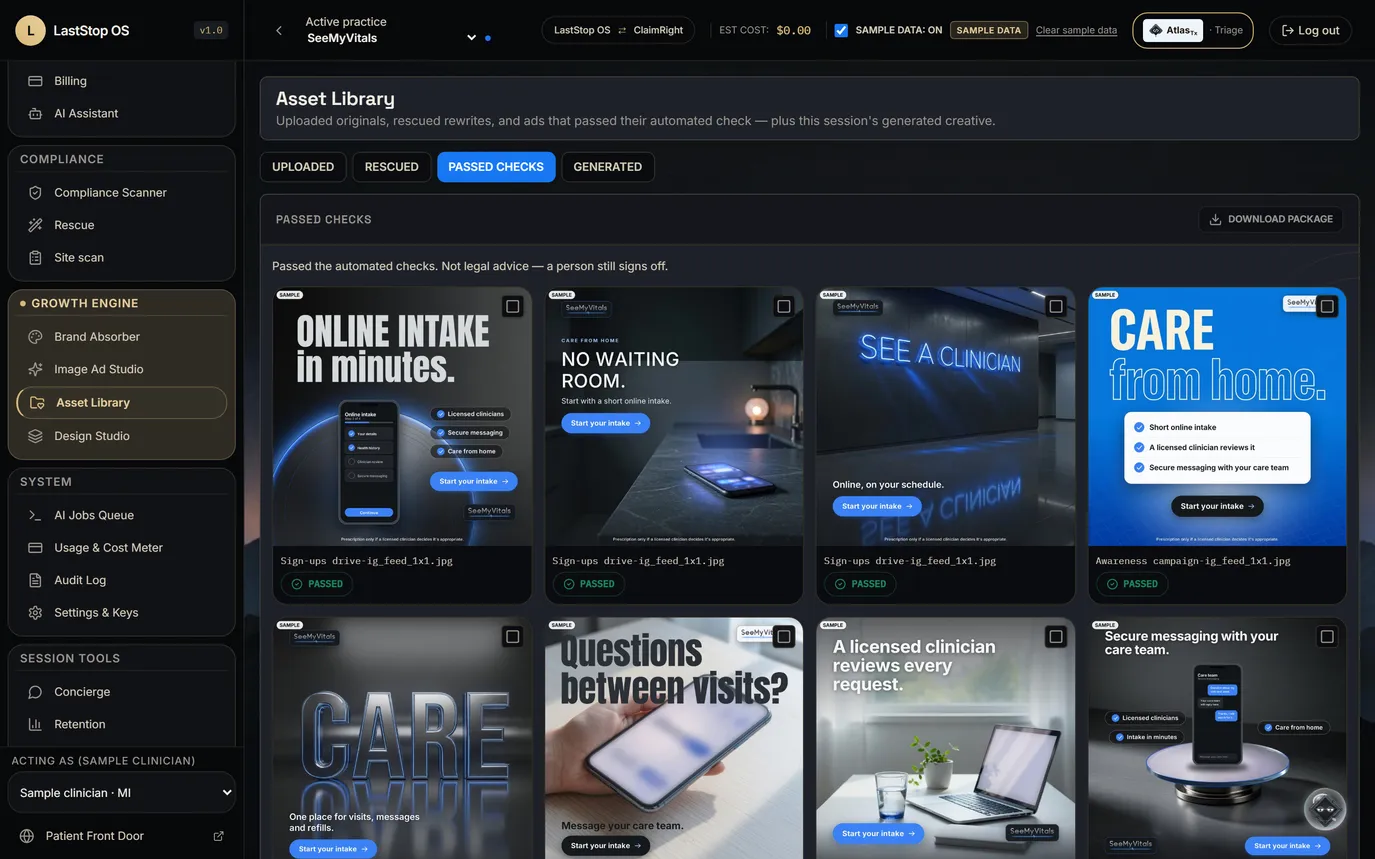
Asset Library
- Three shelves: uploads, ads rescued by a compliant rewrite, and ads that passed.
- Each ad keeps its status and its compliance verdict.
- Download a set as one package, ready to hand to an agency or load into an ad account.
- Today the library lives in this browser session. A server-side library is not built yet.
Every ad that passed or was rescued, on one shelf, ready to download.
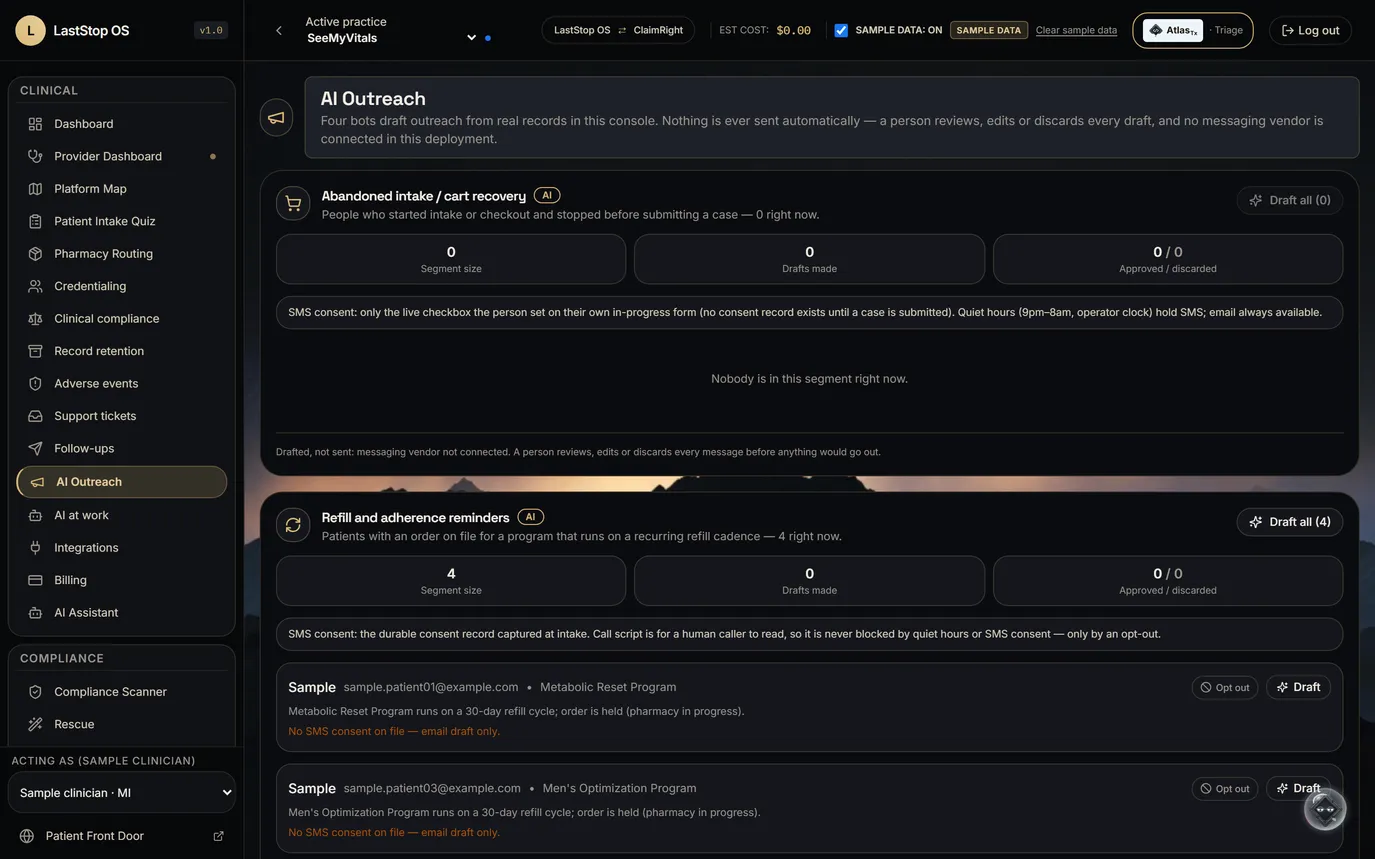
Outreach bots 1 · Abandoned intake and new leads
- The abandoned-intake bot drafts a text and an email for people who started intake or checkout and stopped.
- The new-lead bot drafts first-touch messages for leads who never started intake.
- Texts need a consent record. Quiet hours (9 pm to 8 am) hold texts. Every row has an opt-out.
- No messaging provider is connected, so nothing is sent.
People who stopped halfway get a drafted nudge, within their consent.
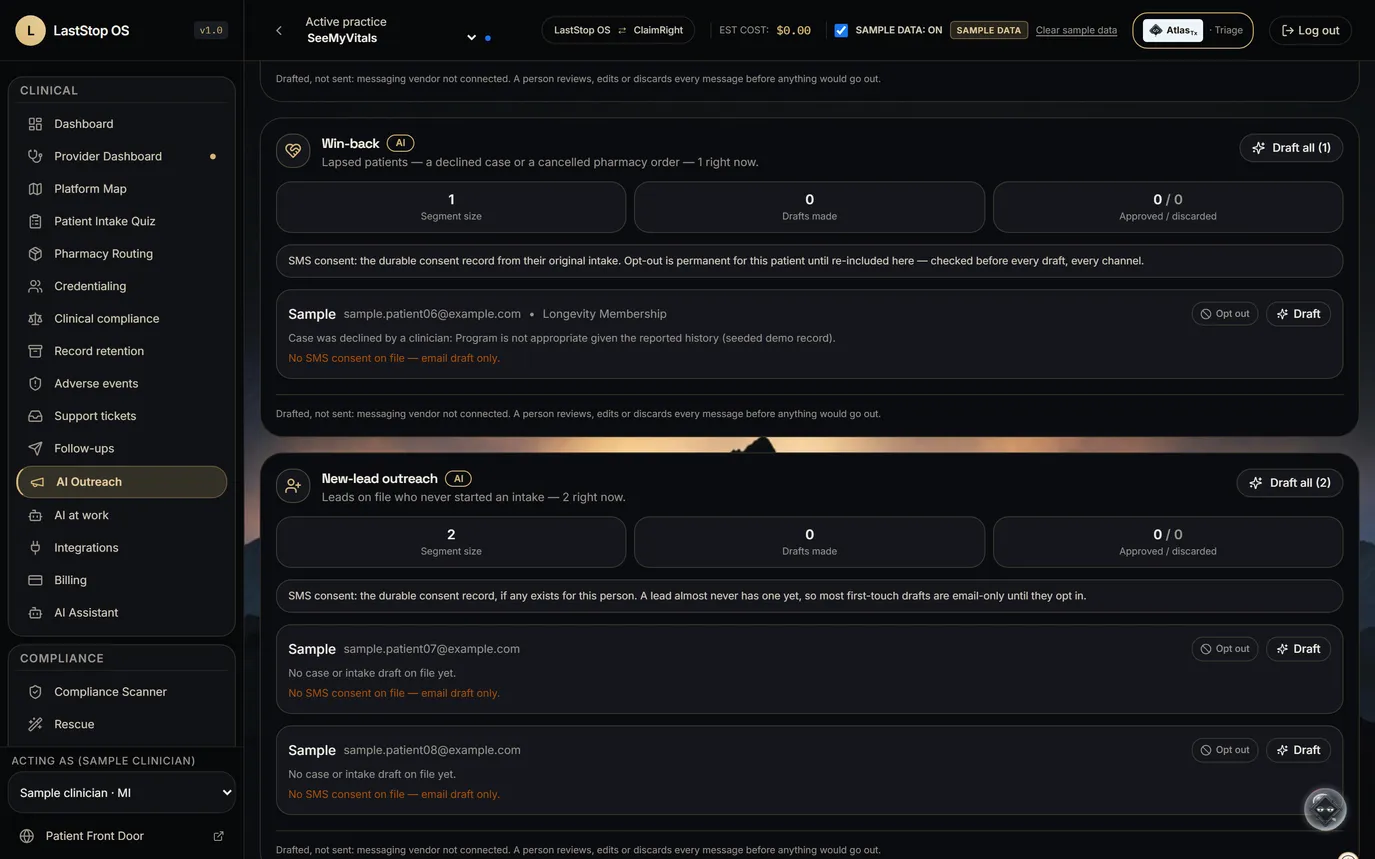
Outreach bots 2 · Refills and win-back
- The refill and adherence bot drafts a text plus a short call script for a human caller when a refill or dose check is due. Four sample patients sit in the refill segment.
- The win-back bot drafts messages for lapsed or cancelled patients and respects opt-outs.
- A person reviews, edits or discards every draft.
- Sending needs an SMS and email provider and carrier registration (10DLC).
A refill due or a patient gone quiet: the draft and a call script are waiting.
Compliance, part 1
Draft rules · need clinician and counsel sign-off
Compliance: the section you don't skip
Two sample ads. Both stopped before they ran.
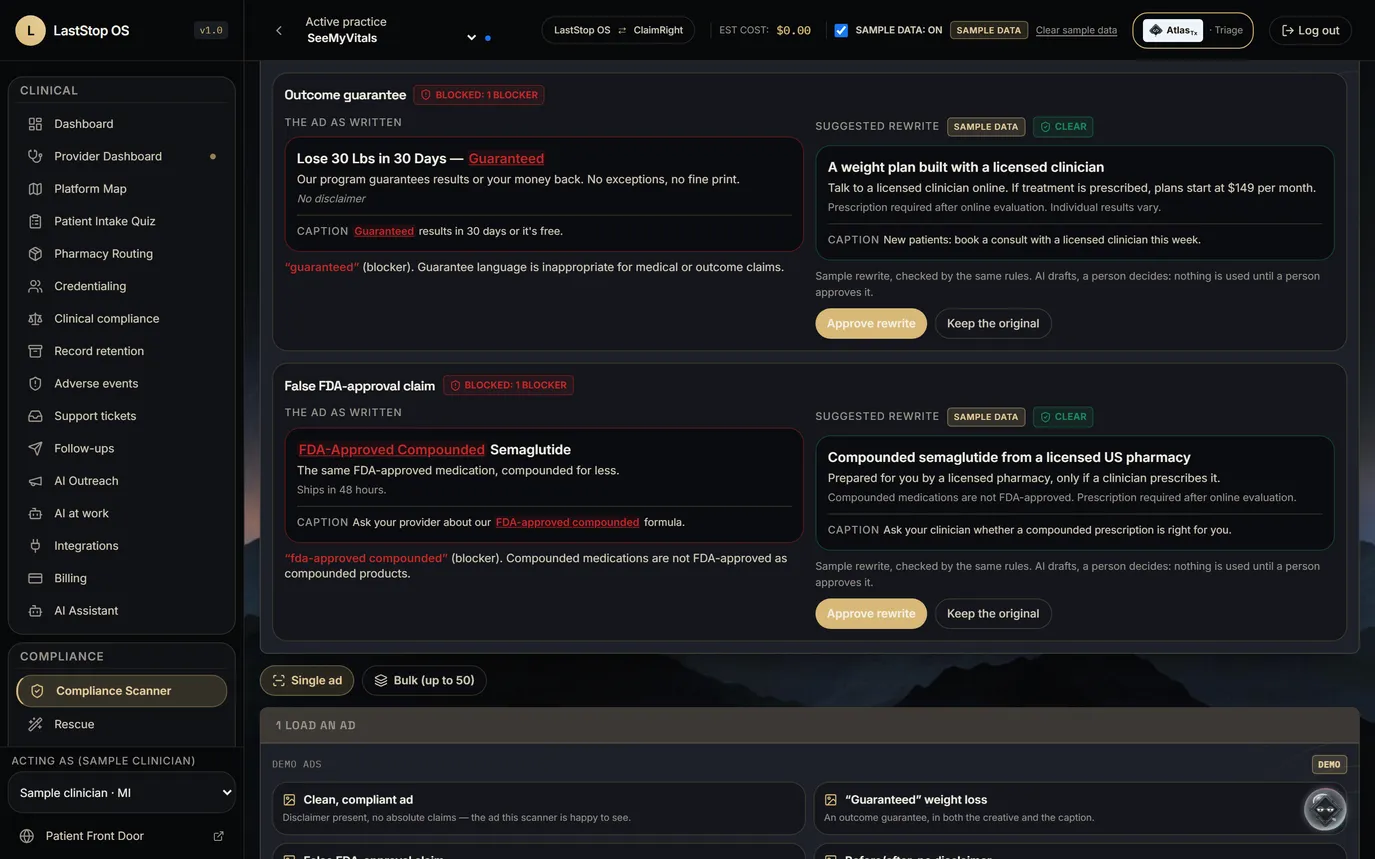
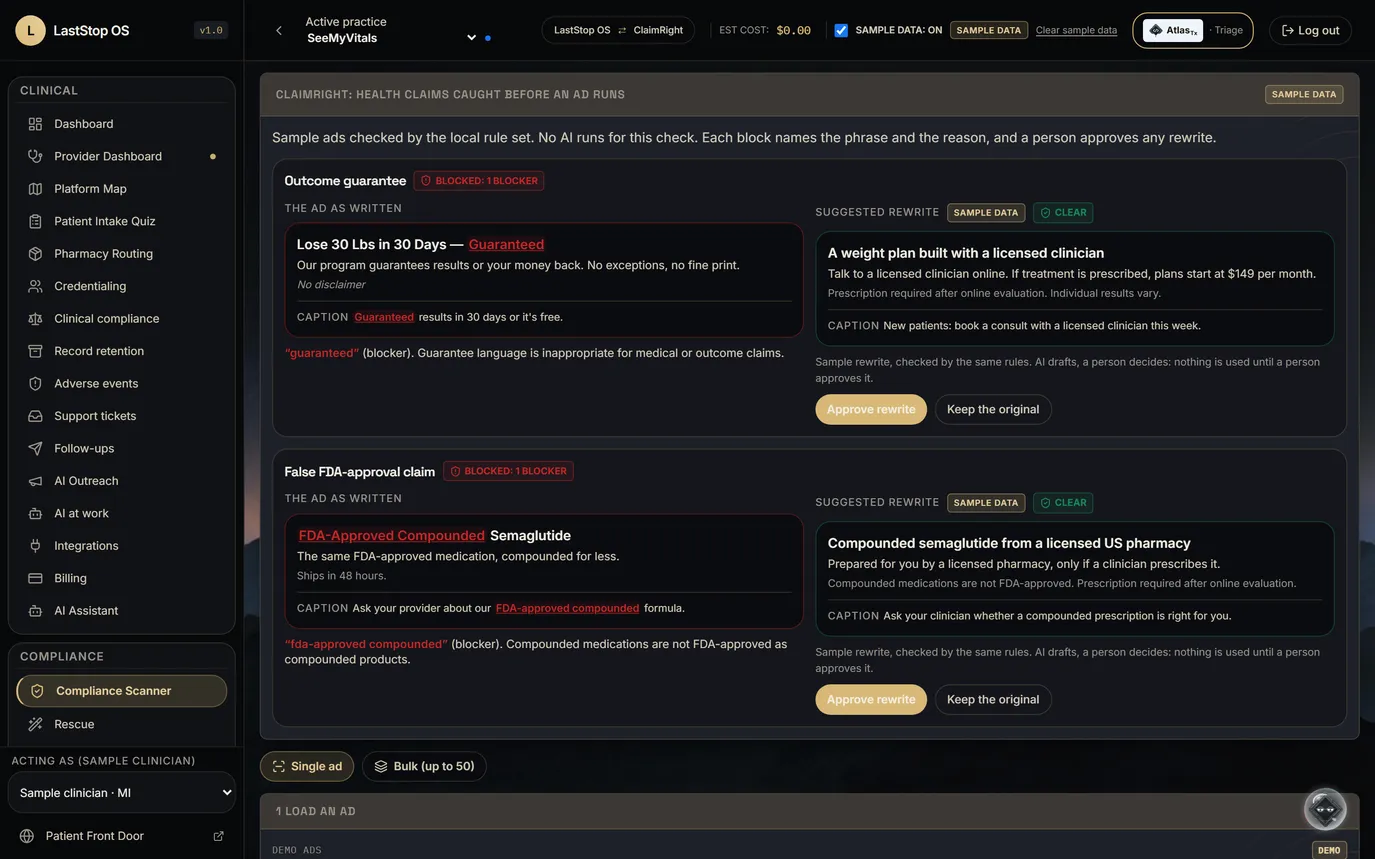
- Behind the stamps: ClaimRight catching an outcome guarantee and a false FDA-approval claim in two sample ads.
- This section covers the claim rules, the FDA disclosure, LegitScript readiness, text consent and STOP, state prescribing rules, visit before prescribe, the licence check, the approval gate, the audit log and Blind Atlas.
- No certification is claimed: LegitScript is not filed, SOC 2 is not started, and no BAA is signed yet.
- These are the controls the practice runs on from day one.
ClaimRight
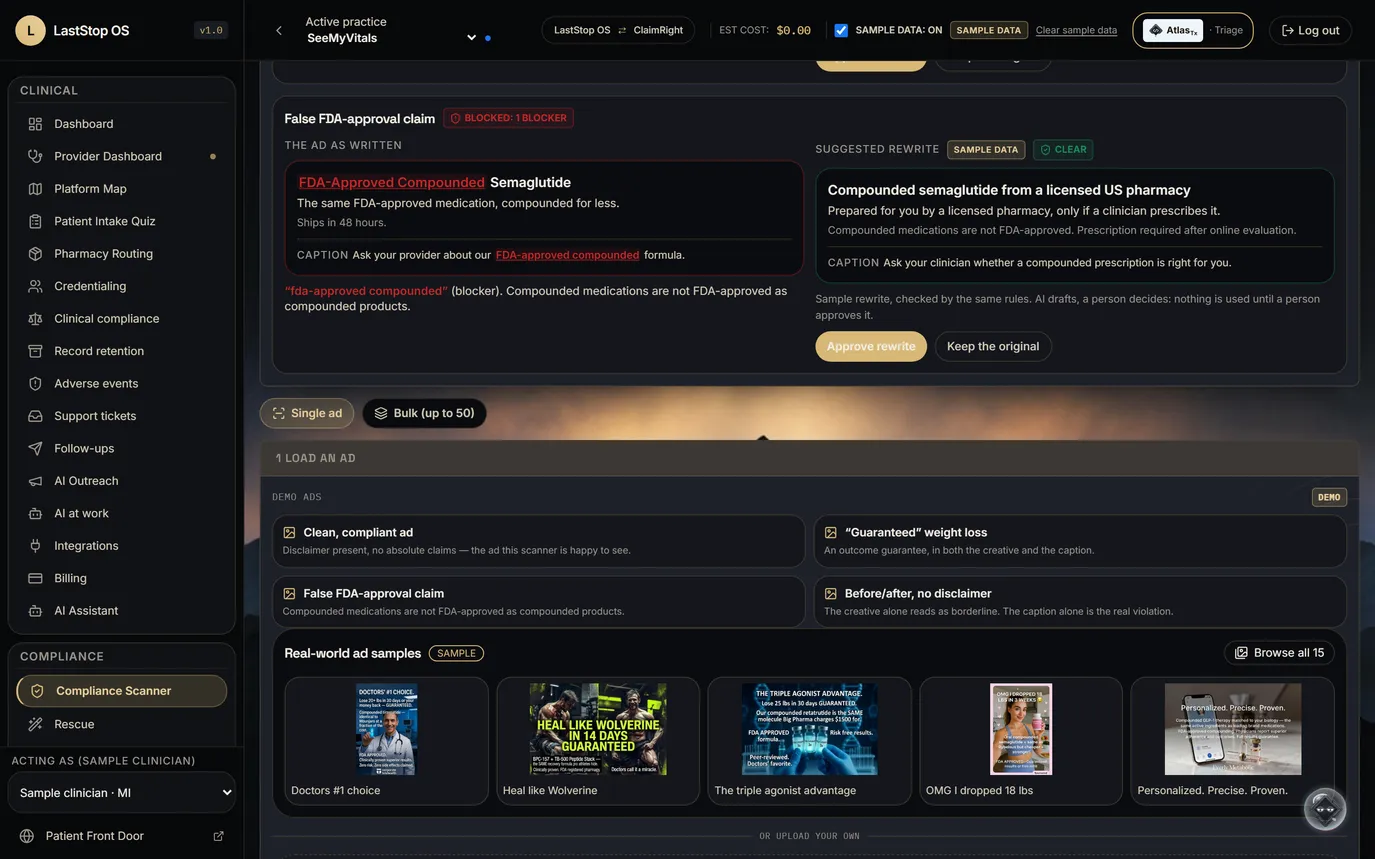
- Two sample ads are blocked, each with the exact phrase, the rule it breaks and a rewrite checked by the same rules.
- The screen: "Sample ads checked by ClaimRight."
- A person approves the rewrite or keeps the original; nothing is used until then.
- The claim rules are drafts that need clinician sign-off. Whole-site scanning is built in the engine.
Health claims caught before an ad runs, with the reason and a clean rewrite.
Outcome guarantee: blocked
- Sample ad: "Lose 30 Lbs in 30 Days — Guaranteed".
- "guaranteed" is a blocker: guarantee language is inappropriate for medical or outcome claims.
- The rewrite: "A weight plan built with a licensed clinician … Prescription required after online evaluation. Individual results vary."
- A person clicks "Approve rewrite" or "Keep the original"; the choice is written to the audit log.
"Guaranteed" is blocked. The rewrite keeps the offer and drops the promise.
False FDA claim: blocked
- Sample ad: "FDA-Approved Compounded Semaglutide".
- "fda-approved compounded" is a blocker: compounded medications are not FDA-approved as compounded products.
- The rewrite adds the disclosure: "Compounded medications are not FDA-approved. Prescription required after online evaluation."
- FDA says it plainly: "Compounded drugs are not FDA-approved."
"FDA-approved compounded" is blocked and rewritten with the real disclosure.
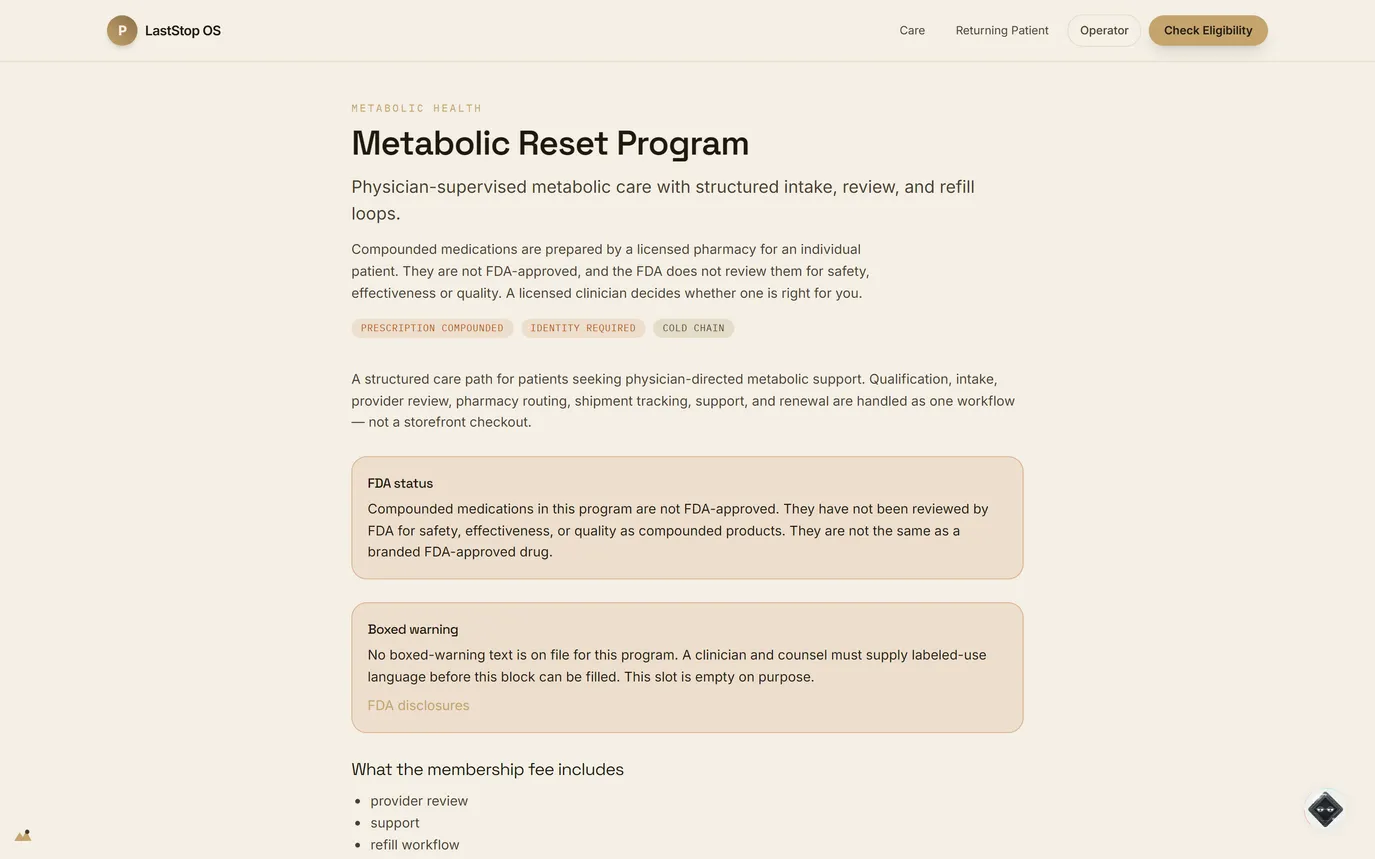
FDA status on every program page
- "Compounded medications in this program are not FDA-approved. They have not been reviewed by FDA for safety, effectiveness, or quality as compounded products."
- The boxed-warning slot is empty on purpose until a clinician and counsel supply the text.
- The wording matches the FDA's own statement.
The disclosure is built into the program page, not pasted on later.
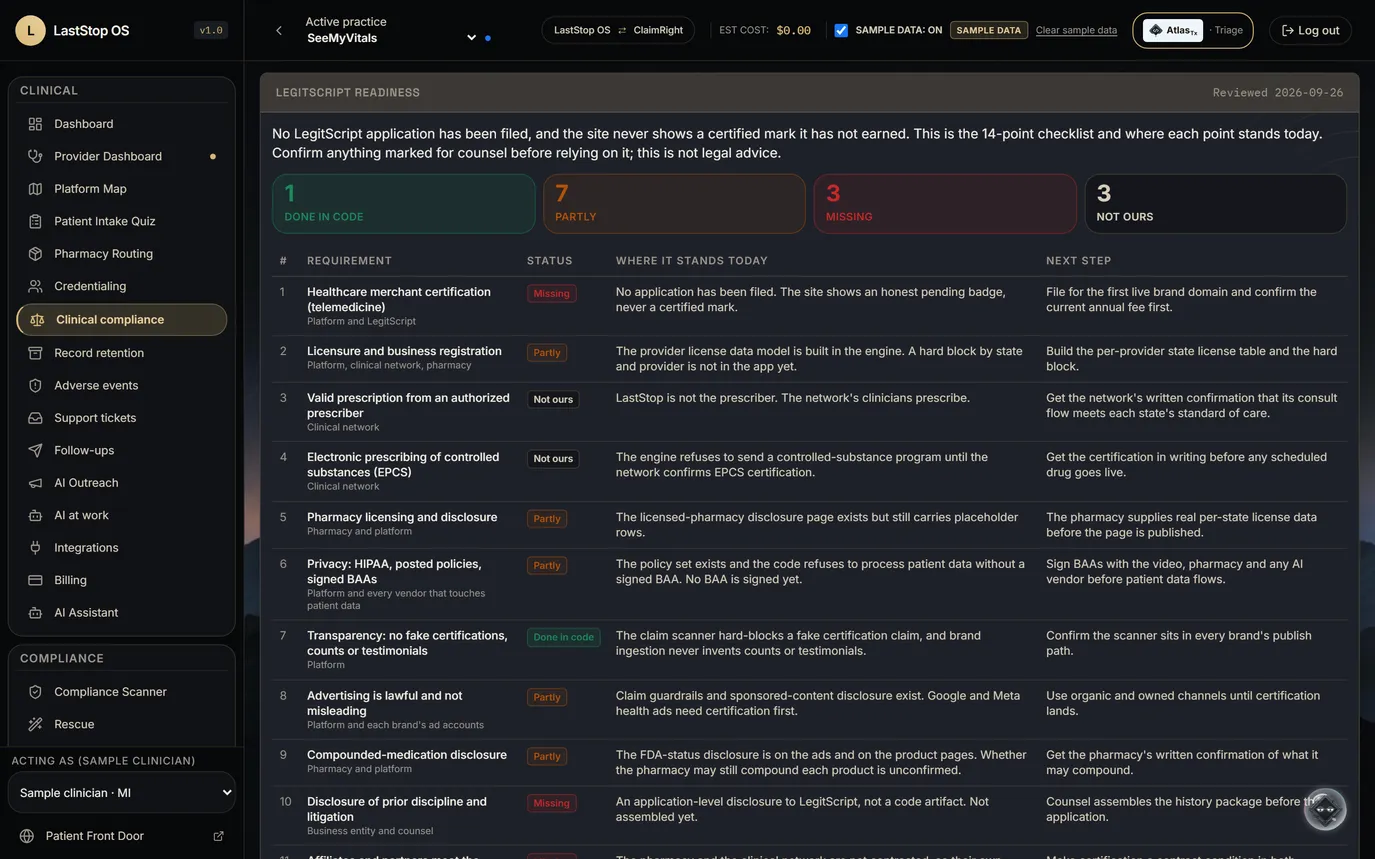
LegitScript readiness
- 14-point checklist, reviewed 2026-09-26: 1 done in code, 7 partly done, 3 missing, 3 that belong to the clinician network or pharmacy.
- No LegitScript application has been filed. The site never shows a certified mark it hasn't earned.
- Google and Meta health ads wait for certification.
- Counsel assembles the disclosure package; the application is filed for the first live brand domain.
14 points to certification, tracked in the product. Not filed yet.
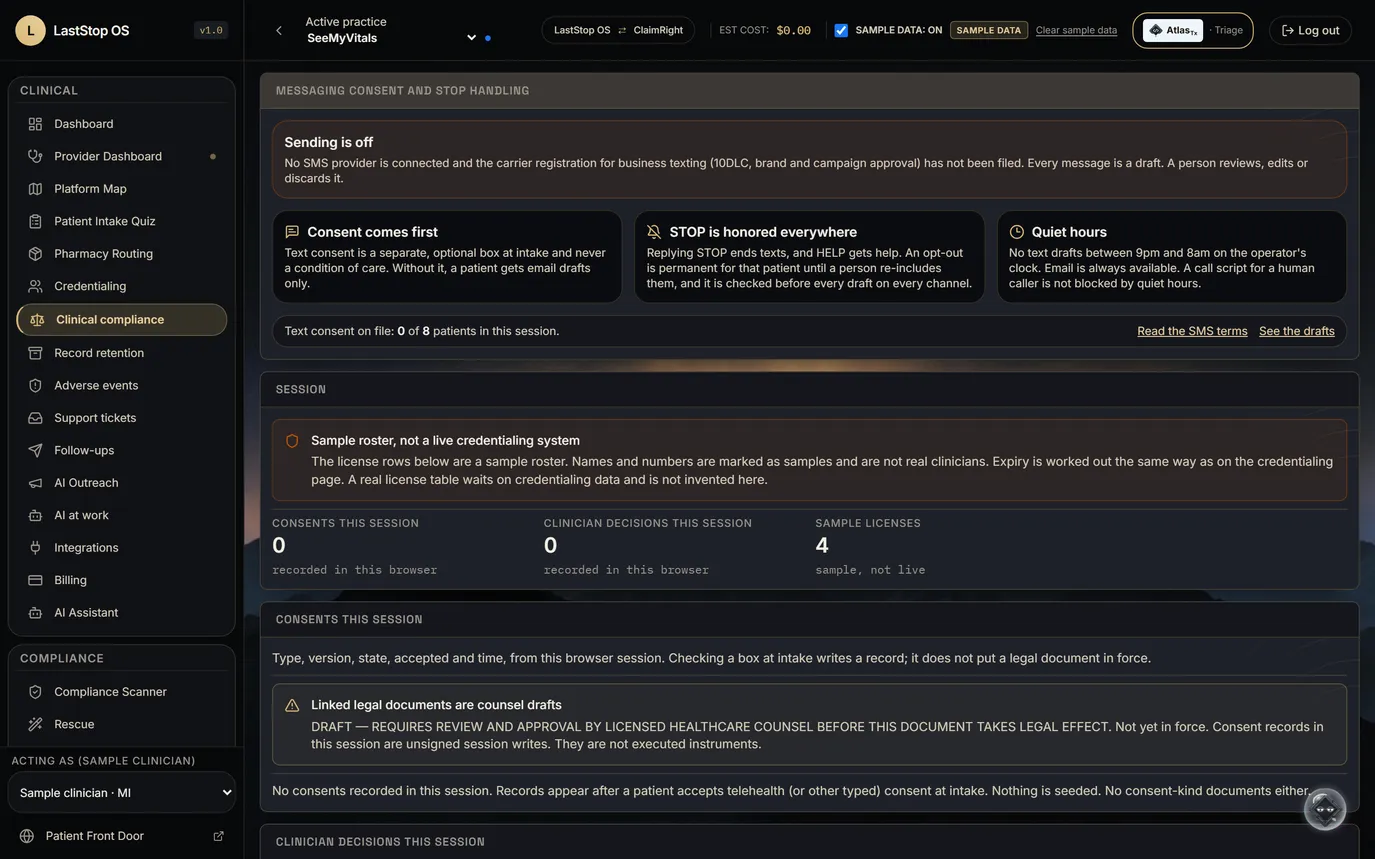
Text consent, STOP and quiet hours
- Consent is a separate, optional box at intake and never a condition of care.
- STOP ends texts until the patient opts back in. HELP gets help.
- No texts between 9 pm and 8 am.
- Sending is off until a messaging provider and carrier registration (10DLC) exist. Consent, STOP and suppression for real sending are built in the engine.
- The legal documents linked here are counsel drafts, not yet in force.
Texts only with consent. STOP is permanent. Nothing goes out at night.
Compliance, part 2
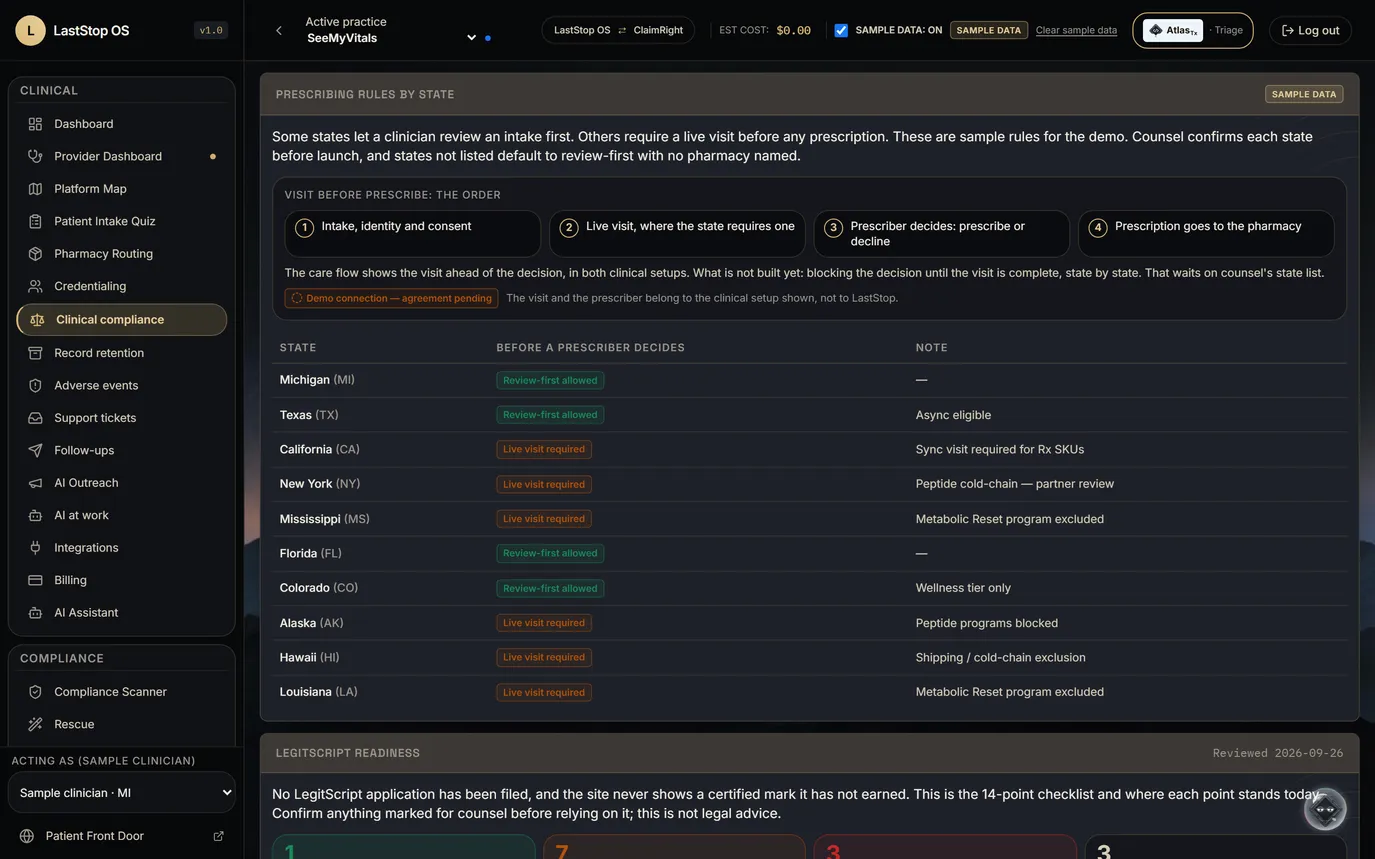
Prescribing rules by state
- Ten sample rules. Some states let a clinician review an intake first (MI, TX, FL, CO); others require a live visit before any prescription (CA, NY, MS, AK, HI, LA).
- States not listed default to review-first with no pharmacy named.
- These are sample rules. Counsel confirms each state before launch.
Review-first or live visit, set state by state before a case moves.
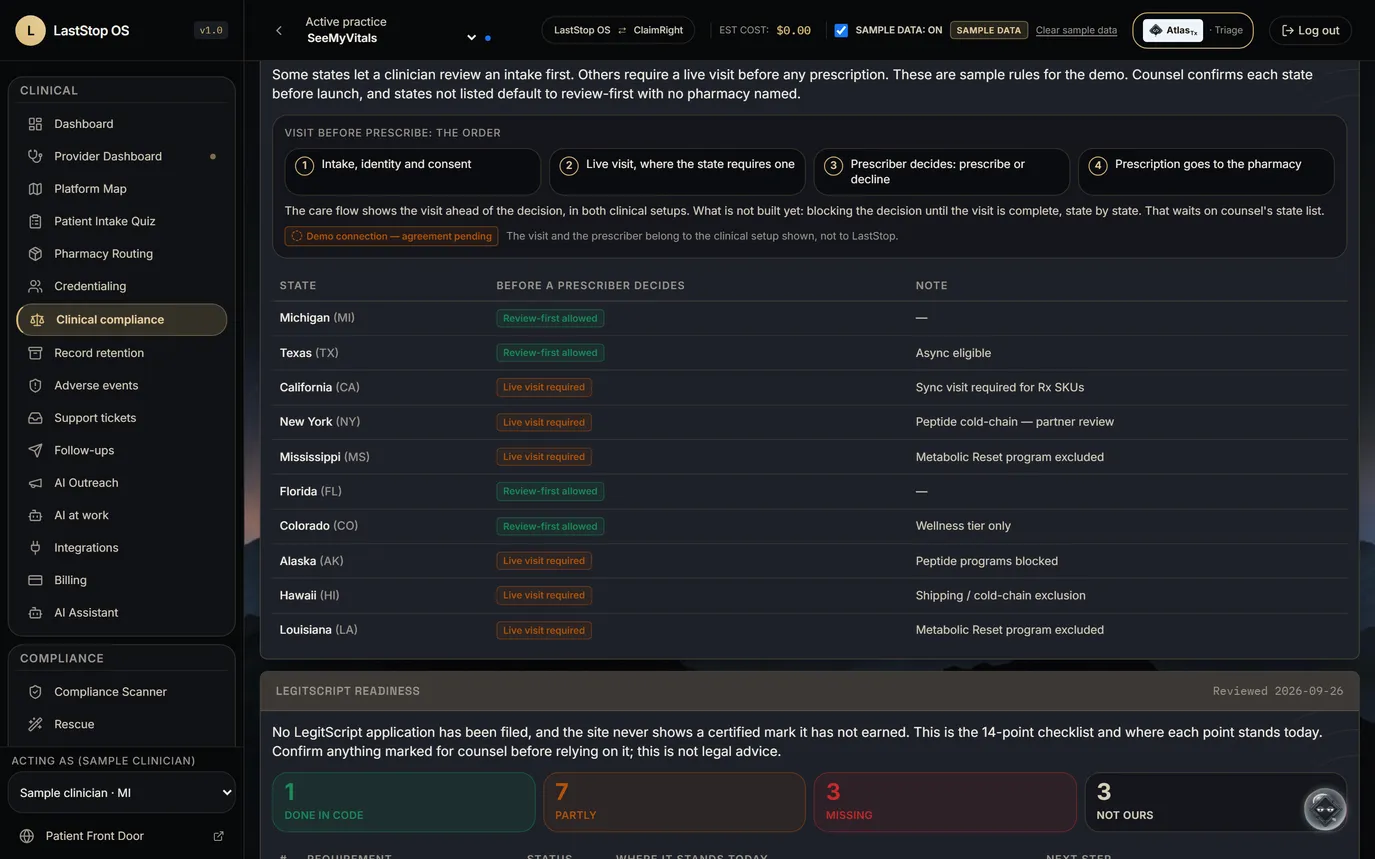
Visit before prescribe
- The care flow puts the visit ahead of the decision in both clinical setups.
- The visit and the prescriber belong to the clinical setup, not to LastStop.
- Not built yet: blocking the decision until the visit is complete, state by state. It waits on counsel's state list.
Intake, visit where required, decision, pharmacy. In that order.
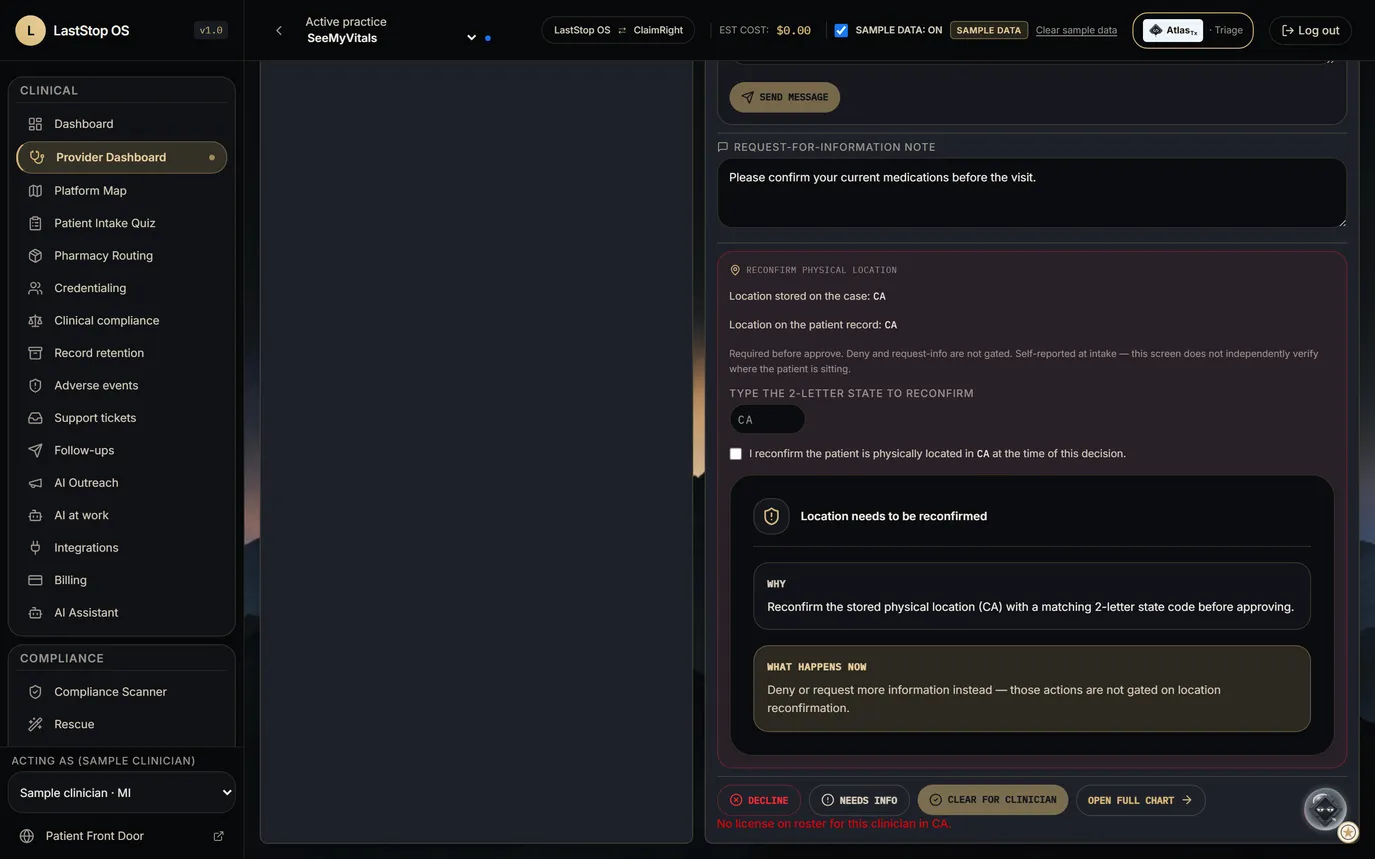
Clinician licence check
- The sample clinician is licensed in Michigan; the case is in California, so the decision is refused.
- Before any approval, the patient's physical location is reconfirmed with a matching two-letter state code.
- Decline and request more information stay available; approval waits for a clinician licensed in that state.
- A working gate on a sample roster until real credentialing is connected.
A clinician not licensed in the patient's state can't approve the case.
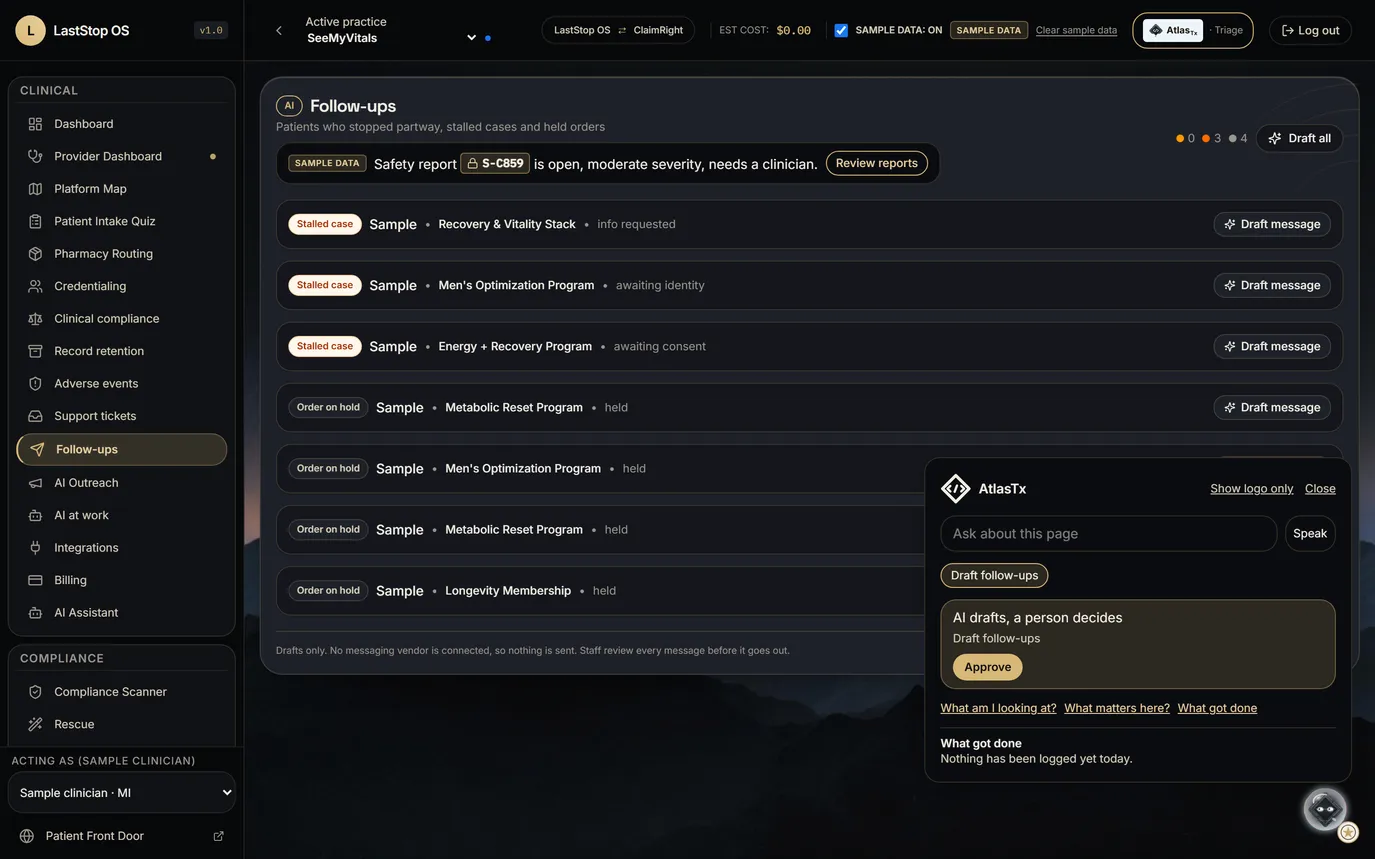
AI drafts, a person decides
- AtlasTx offers "Draft follow-ups"; the card reads "AI drafts, a person decides" with one Approve button.
- After approval the drafts appear for review. Nothing is sent.
- "What got done" lists each approved action, and each one goes to the audit log.
Nothing the AI drafts runs until a person approves it.
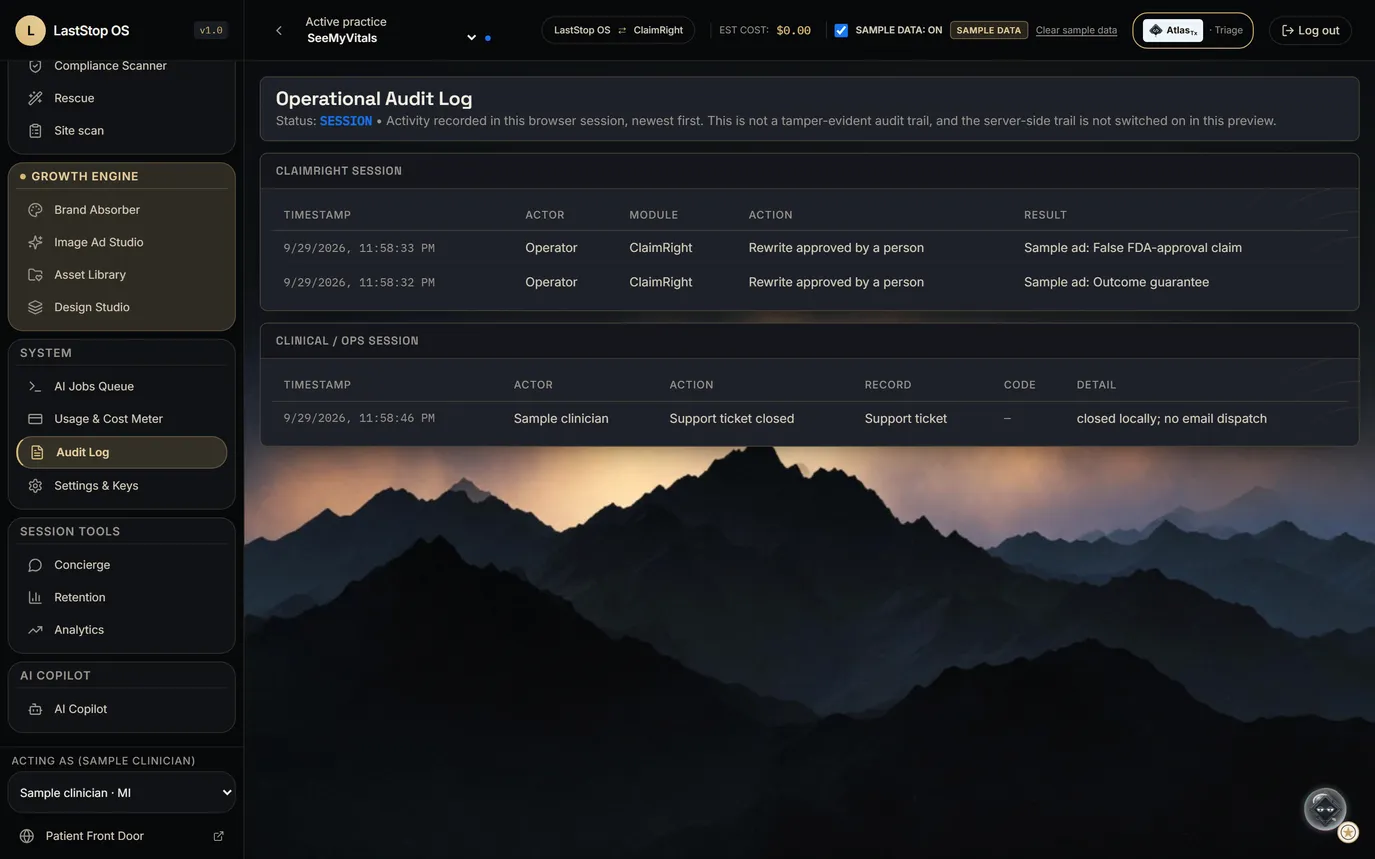
The audit log
- The two ClaimRight rewrites approved in this session and a support ticket closed by the sample clinician, each with time, actor, module, action and result.
- In the demo the log is kept in the browser session. A tamper-evident server ledger is built in the engine.
What happened, who did it, and what came of it.
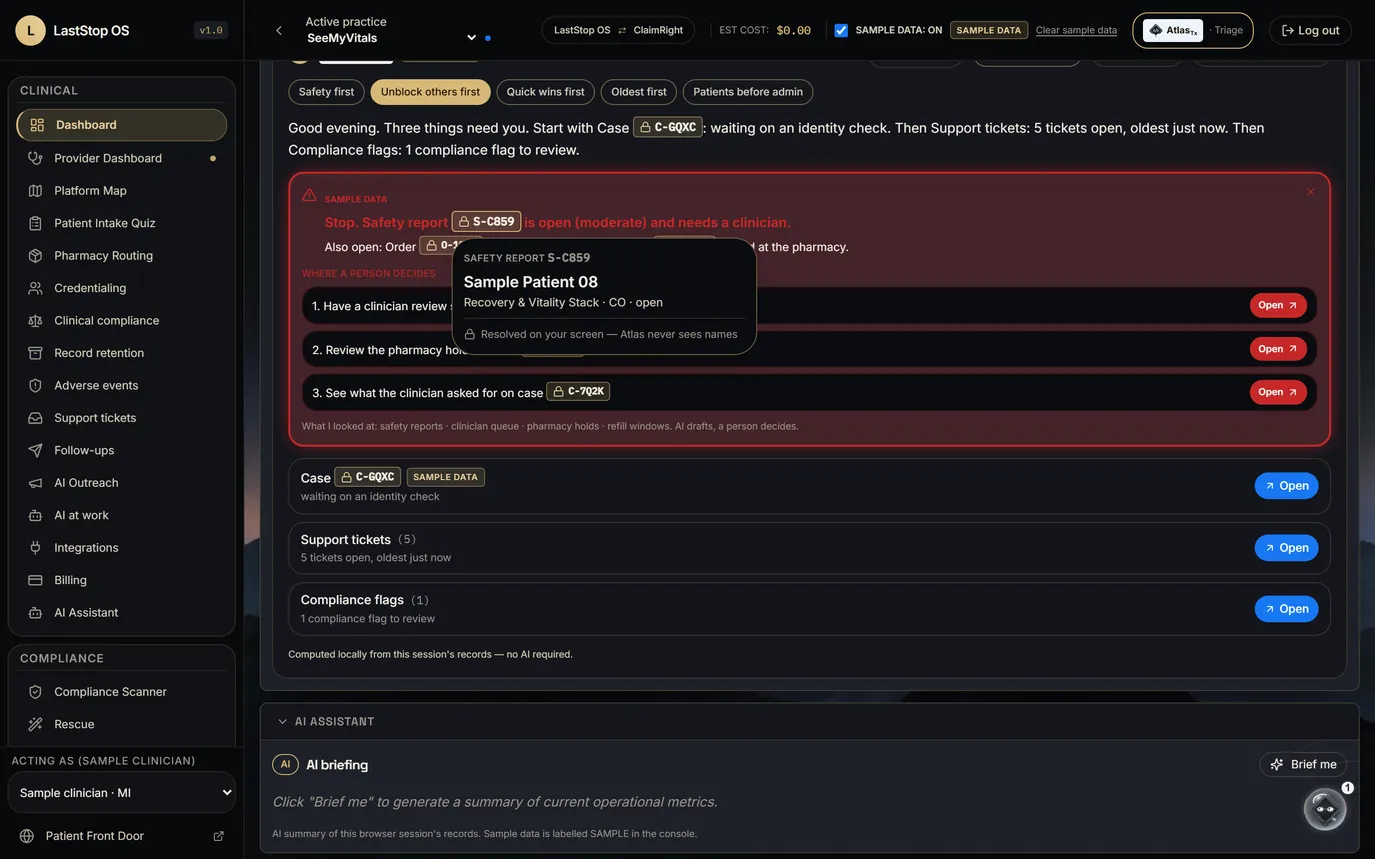
Blind Atlas, from the fire card
- Clicking the code on the fire card resolves it to "Sample Patient 08 · Recovery & Vitality Stack · CO · open", on this screen only.
- Atlas received the code, the status and the elapsed time. Nothing else.
- The HIPAA basis: random codes (45 CFR 164.514(c)), the Safe Harbor identifiers removed (164.514(b)(2)), relative times only, no free text.
- Privacy counsel review of the design is pending.
The report behind S-C859 resolves on your screen, and only there.
Jobs and money saved
What it takes off the payroll
6.5 FTE of non-clinical work covered at about 300 active patients a month.
| Role | FTE | BLS median | Monthly | Annual | Loaded | Basis |
|---|---|---|---|---|---|---|
Office / operations manager (daily triage)AtlasTx · SOC 43-1011 | −0.5 | $69,500 | $2,900 | $34,750 | $49,650 | Built today |
Refill and follow-up coordinatorAtlasTx · SOC 43-6013 | −1 | $45,930 | $3,850 | $45,930 | $65,620 | After agreements |
Patient support representativeAtlasTx · SOC 43-4051 | −0.5 | $44,770 | $1,850 | $22,385 | $31,980 | After agreements |
Intake and eligibility coordinatorLastStop · SOC 43-6013 | −0.5 | $45,930 | $1,900 | $22,965 | $32,810 | Built today |
Pharmacy order coordinatorLastStop · SOC 43-4151 | −0.5 | $46,170 | $1,900 | $23,085 | $32,980 | After agreements |
Brand and identity designerGrowth Engine · SOC 27-1024 | −0.5 | $62,960 | $2,600 | $31,480 | $44,980 | Built today |
Ad designer (production)Growth Engine · SOC 27-1024 | −0.5 | $62,960 | $2,600 | $31,480 | $44,980 | Built today |
CopywriterGrowth Engine · SOC 27-3043 | −0.5 | $76,910 | $3,200 | $38,455 | $54,940 | Built today |
Lifecycle marketing specialistGrowth Engine · SOC 13-1161 | −0.5 | $78,760 | $3,300 | $39,380 | $56,260 | After agreements |
Compliance manager (program)ClaimRight / Compliance · SOC 13-1041 | −0.5 | $80,730 | $3,350 | $40,365 | $57,670 | Built today |
Marketing-claims reviewerClaimRight / Compliance · SOC 13-1041 | −0.5 | $80,730 | $3,350 | $40,365 | $57,670 | Built today |
Privacy and consent administratorClaimRight / Compliance · SOC 29-2072 | −0.5 | $51,140 | $2,150 | $25,570 | $36,530 | After agreements |
BLS Occupational Employment and Wage Statistics, May 2025 national medians (bls.gov/oes). Fully loaded uses the BLS Employer Costs for Employee Compensation ratio, $46.89 ÷ $32.82 = ×1.43 (bls.gov ECEC).
Front ends
The patient portal
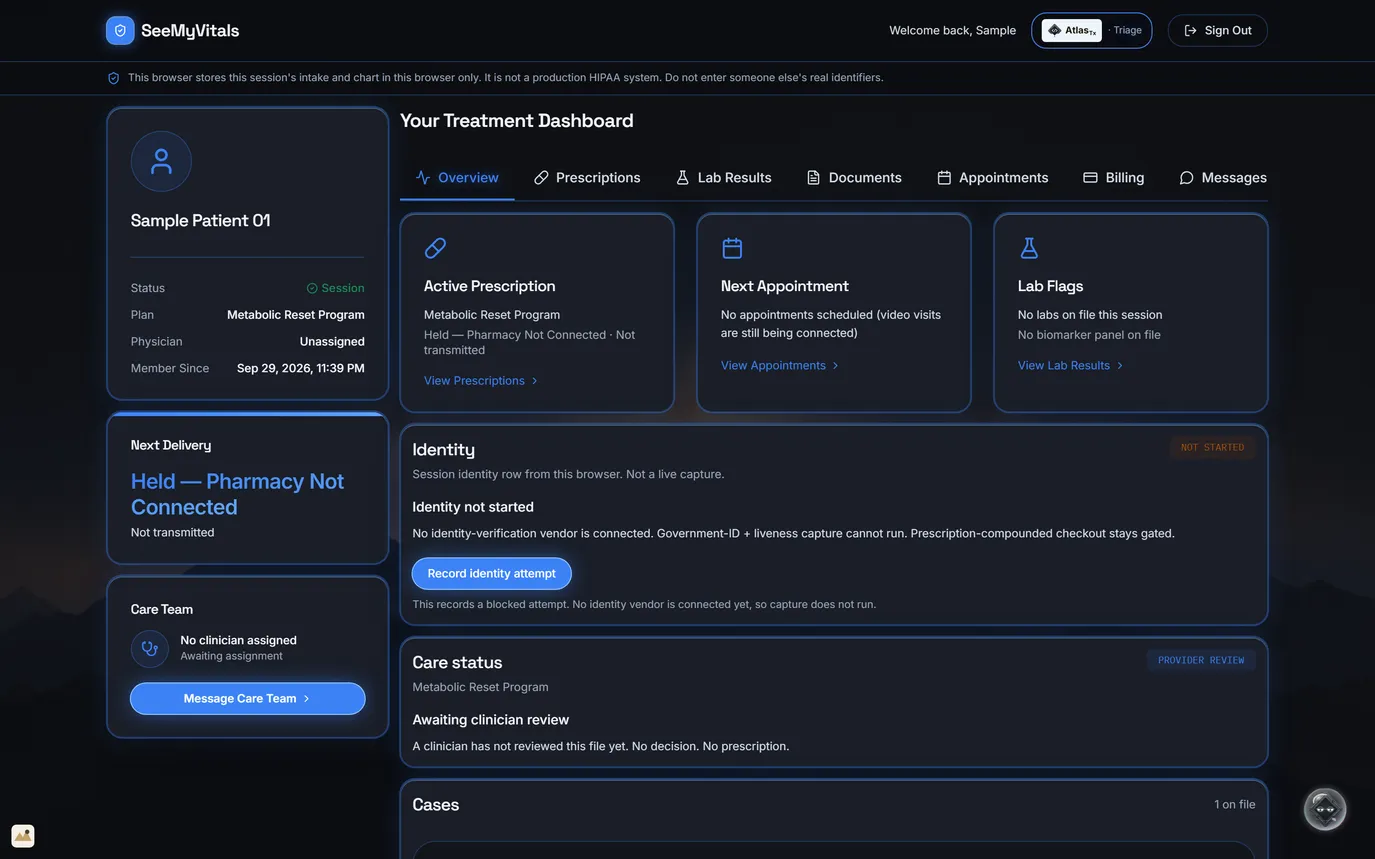
What the patient sees: plan, prescription, next visit, care status.
- Plan, active prescription, next appointment, lab flags, care status and cases for a sample patient.
- The sample case is waiting for clinician review: no decision, no prescription, and nothing sent to Hallandale Pharmacy (demo connection).
- Patient sign-up and login are built in the engine; the demo uses session data.
- Video visits: the connector is built in the engine and waits on a key and a BAA.
Refills
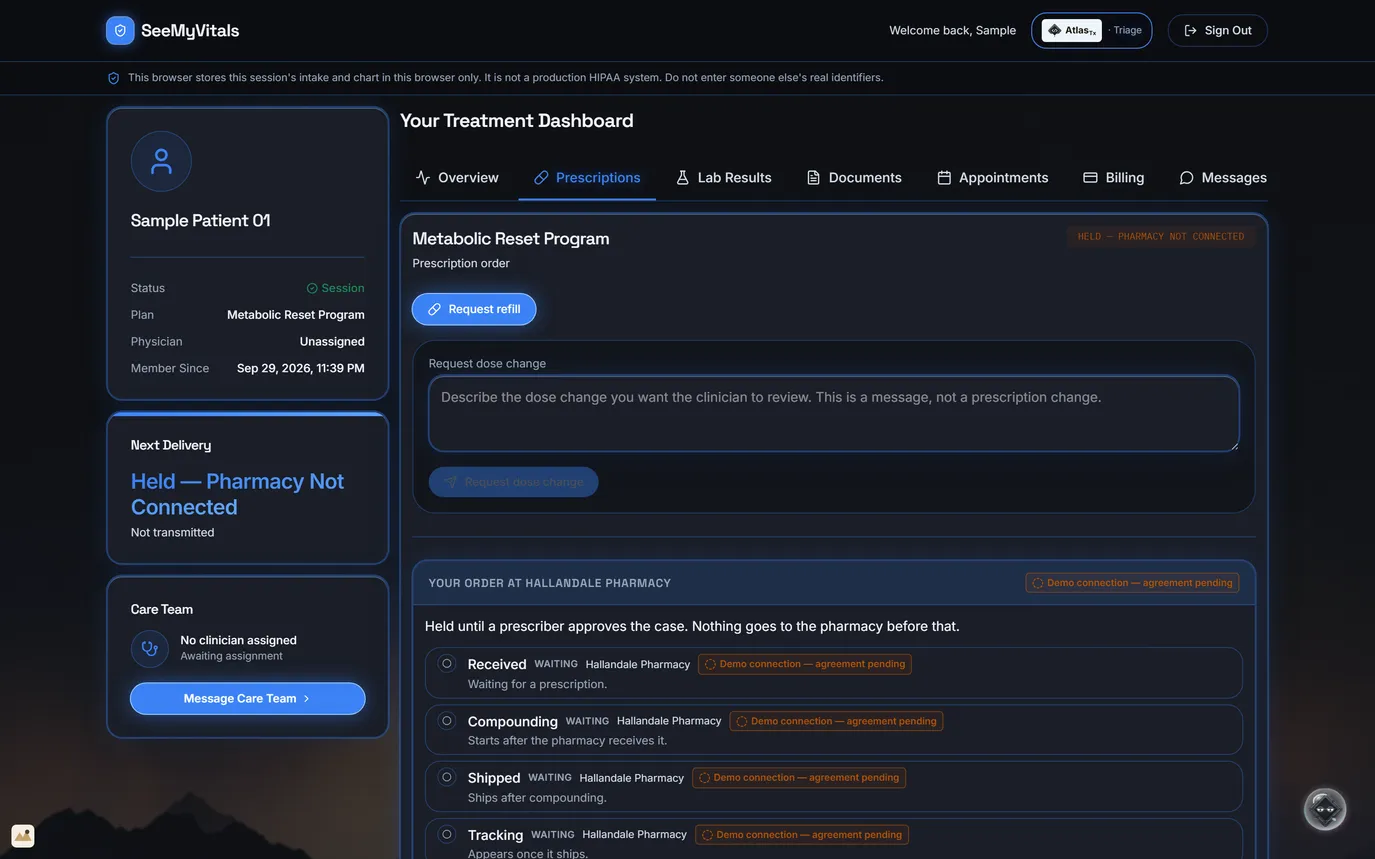
- Refills open in the last week of a 30-day supply.
- The request goes to the clinician, then to Hallandale Pharmacy only after approval, then ships with tracking.
- The engine's refill request and recheck gate are built.
Refills go to the prescriber first, then the pharmacy. Never the other way round.
Secure messages
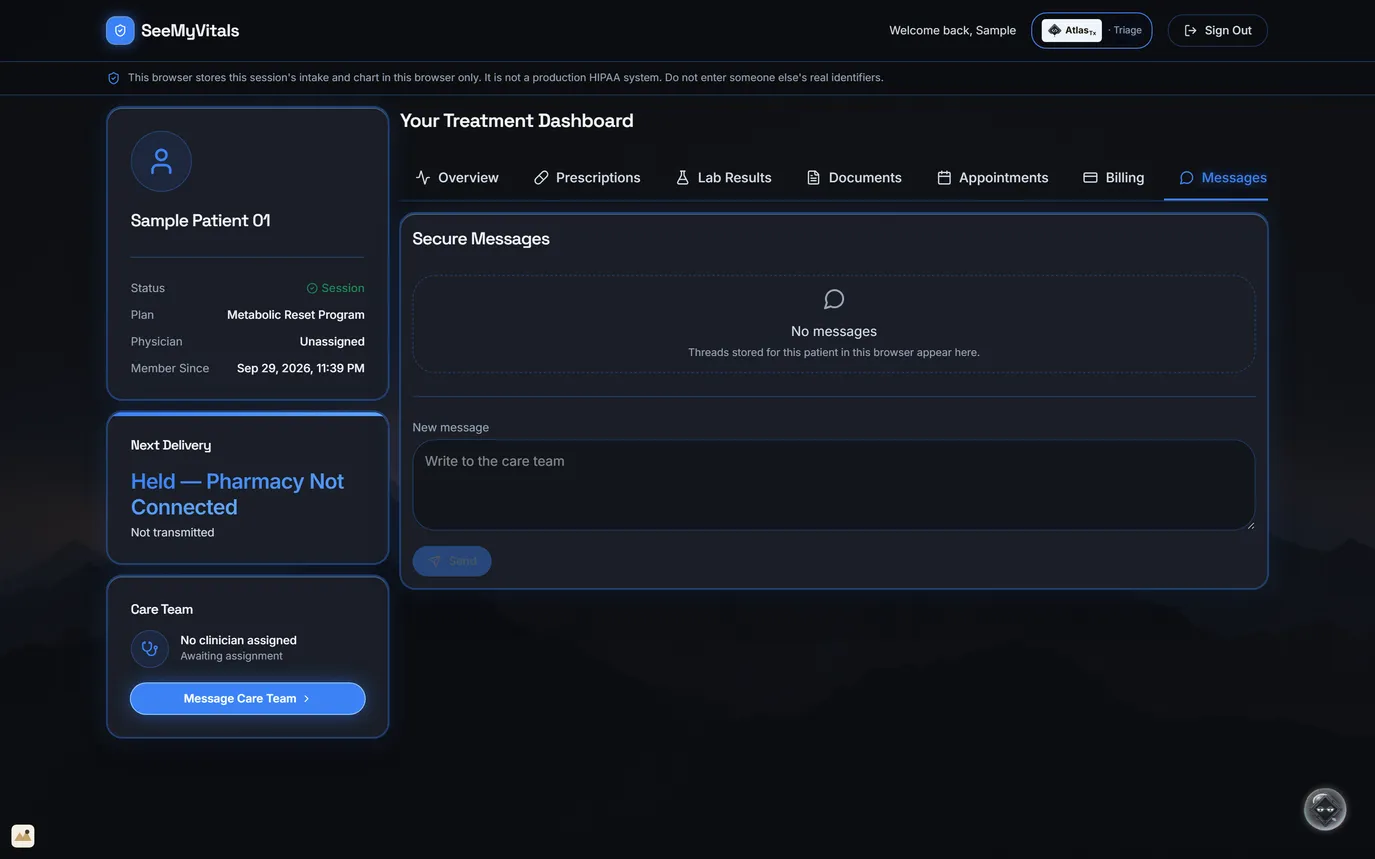
- The sample patient has not written yet, so the thread is empty. A new message goes to the care team.
- Staff or clinicians answer. Clinical questions go to a clinician.
- In the demo, threads live in the browser; server-side messaging is built in the engine.
Patients write to their care team, not to a shared inbox.
Billing, stated plainly
- No plan price, card on file or invoices, because the payment processor is not connected.
- Card details are never fabricated.
- Cancel is offered in the portal.
No processor connected, so no price, card or invoice is invented.
On a phone
- The dashboard, AtlasTx, record codes and the care flow fit a 390-pixel phone screen without sideways scrolling.
- The patient portal is laid out for the same width.
- SAMPLE DATA stays visible on the phone.
- Anything that sends or changes a record still needs an approve tap.
- Perfectly wrapped to fit your phone. iOS and Android apps are planned, for you and your patients.
The whole console fits a phone.
What's real today
- Built: the platform and its four pillars, shown here on labelled SAMPLE data from a local demo build.
- Waiting on signatures: the pharmacy, a clinician network or EHR, the payment processor, BAAs, a messaging provider and 10DLC registration, the LegitScript filing and counsel review.
- Not claimed: patients, orders, revenue or certifications.
- Next in the build: host the engine and wire the app to it, so every screen runs on real records.
Built and demonstrable today. Live with patients after the agreements are signed.